Tuesday, March 27, 2018

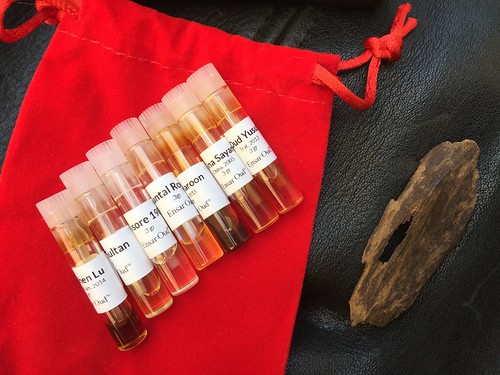
Ensar Oud - First Impressions

The World of Oud and Sandalwood Oils

Part of the art of selling single ingredients commodities such as tea lies in the ability of labeling and dating them appropriately with a memorable name. Dealing with oud is no different, with each specimen having a limited supply and very high demand.

Ensar Oud has done an outstanding job in not only sourcing a wide variety of pure oud oils (for wearing neat on the skin, I thought you might ask) and wood (for burning) - but also giving them imaginary names.

Ensar Oud does that with enticing names that make it a lot more memorable than just dates and numbers (although these do have their place and value in recognizing and comparing various aromatic specimens).

Jing Shen Lu
Khao Ra Kam, 2014 
Straight from the vial: Notes of spikenard, a tad minty-cool, alongside pungent notes of paint, tar and carbolineum. Reminiscent of antique patchouli as well.
On the skin: Elegant, clean, cool yet also spicy. Vetiver, berry and grass notes - reminiscent of nagramotha and davana mixed together. Tobacco-like with hints of helicrysum also.
Dryout: Woody, sweet yet clean.

China Sayang
China, 2005
Straight from the vial: Musty, old furniture, yet also mellow. Another time it smelled intense animal odours to me - like being surrounded by goats and camels, or sitting in a tent made of goat's hair and sheep's wool, dusty old cow cakes, and visiting caves where the above animals slept in.
On the skin: Grows warmer and sweeter on the skin.
Dryout: Dusty, with the animalic barnyard remnants persist. I happen to be very fond of goats, but find that wearing this on its own is a bit too realistic. I would be curious to blend it in a perfume where it would add a surprising element but only hint to the animals, without smelling so literal.

Oud Haroon
Siam, 2015
Straight from the vial: Funky, animals, valerian, hint of mint, mushroomy (like sour Cepes absolute), Marmite undertones. All in all quite yeasty.
On the skin: Strong yet somehow dull and flat.
Dryout: Becomes cooler woodier as it dries on the skin. Elegant finish to a rather funky beginnings.

Oud Yusuf
Trat, 2012
Straight from the vial: Although it begins with a blow of gasoline fumes notes that brings to mind the rather harsh opening of nagramotha (AKA Cypriol, a type of papyrus with a scent that closely resembles vetiver) - this is the mellowest of the four. Berry-like and smooth-wood body, with dusty clay and dried figs undertones.
On the skin: Clean woody. Hints of roasted nuts and coffee. A tad floral, perhaps even rosy. With herbaceous-grassy undertones, reminiscent of chamomile and blonde tobacco.
Dryout: Warm-woody, a little like vetiver.

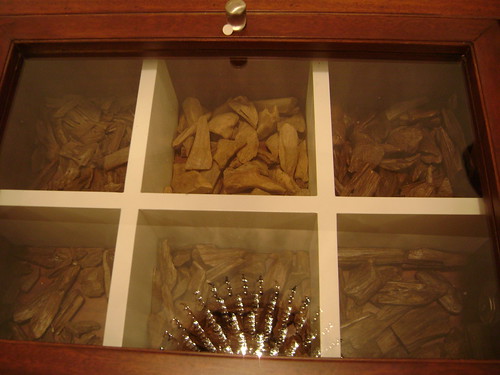
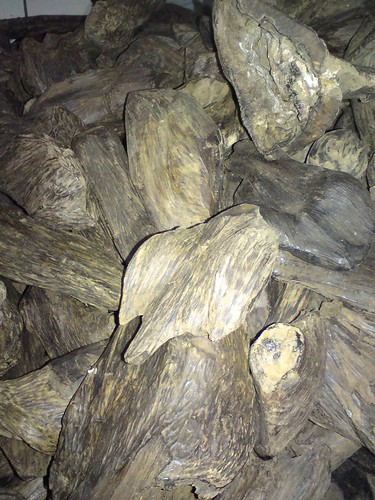
After sampling oud oils and woods in various circumstances, I came to the realization that this is one of the most curious, sneaky and fascinating raw materials. It makes a huge difference when, how and where you experience the scents (as burned or warmed wood chips; oils on your skin or on paper or in the vial, etc.). Also, the order in which they are smelled makes a huge impact on their perception. If I were to smell these four ouds in a completely different order, they would smell quite different. I would recommend actually not smelling them side by side but immersing yourself completely in one at a time (which I would do later for each one of the oud oils I have in my collection).

If you decide to warm the oud chips as incense, using the Japanese koh-doh method, try different sequences of the ouds you have. Take lots of notes, not for others to read, but for yourself. It helps a great deal to refine the sense of smell and one's perception, and to pay more attention to the many nuances in these rich and complex treasures. Also this will help you to memorize the very confusing array of ouds available - which may seem useless for a layperson, but if you want to share these treasures with friends and host a little incense party - it will be very helpful to know what you're burning and in which order to place them. It will greatly affect the experience. For example: if a scent is very strong its best to place it last after the more subtle specimens. Also, memorization of what you have will help you enjoy more and be able to better appreciate other ouds that you stumble upon in other places.


Labels: , , , , , , , , ,

Thursday, December 11, 2014

Oud Truffles


Yes, you heard it right:
Oud truffles.
As in chocolate, with oud in it, to eat and enjoy.

This is very unconventional flavour. It creates more of an aroma that enhances the chocolate.

The occasion is my book signing event: I was thinking - what would be reminiscent of old libraries, leather-bound books, something mysterious, alluring and totally out there? First I was thinking ambergris (which I've already created before for my Orcas perfume launch - with amazing result). I had a sniffing session of oud the other day with my student (who's originally from Kuwait - she's in fact, the daughter of an Arabian perfumer and oud merchant). As a result, oud was on my mind... I had a hunch that oud would create a similar effect to that of ambergris - bring the best out of the chocolate. I was right.

I've used an incredibly animalic, rich, and slightly berry-like oud (the same one that I use in my Razala perfume). The result was everything I hoped and non of the bitterness I feared that would result from adding wood oil to the already-bitter 72% dark cocoa. It blossomed into this spectacular, slightly flowery chocolate. Rich in aroma, intriguing, intense, but also very refined and not in the least overpowering. I'm going to pair it with a nice big red, spicy wine like Zinfandel or Shiraz tonight!
Please join me!

Labels: , , , , , ,

Friday, April 02, 2010

Song of Songs + Giveaway


Book of Love, originally uploaded by Thorne Enterprises.

The book of Canticles (aka Song of Solomon or Song of Songs) is traditionally read on the morning of the Sabbath during Passover. Hence, my perfume bearing that name is particularly appropriate for this time of year and I thought it would be a great start for talking about how to use oud in perfumery, revealing the different facets of its complex beauty.

I created Song of Songs perfume using the ancient perfumes mentioned in this book, including agarwood, spikenard root, oils of myrrh and frankincense oils, and labdanum absolute, which together form a resinous and woody base; a bouquet of roses (from Morocco, Turkey and Bulgaria) for the heart, and saffron absolute at the top, which makes it very exotic and unusual. At some point I had some hyacinth absolute in my organ, which I used for the heart as well, but this is long gone. The hyacinths stand for the lilies mentioned in the poem, and which according to my research were what the Song of Songs refers to as "Lily of the Valley" (convillarias do not grow in Israel or anywhere in the Middle East). Hyacinth absolute is very sweet (almost candy sweet) and with some green-herbaceous aspect. But like I said - it rarely turns out in the market. I also had an idea of having cedar in it at certain point in the design process, but that was more of a story-telling idea, rather than perfumed idea (the book mentions cedar of Lebanon, which was used to build the temple of Solomon; however I don't know that cedar was necessarily a biblical perfume material so I abandoned that idea early on).

Song of Songs is honeyed, resinous and exotic and has a very profound impact on my mind when I wear it. It makes me feel connected to the ancient civilizations where my ancestors came from. There. the Orient and the Occident unite through veins of caravans transporting spices, medicine and wisdom. Like the poem it was inspired by, the perfume sits comfortably between the sacred and the profane (despite the fact that the poetry in the book of Canticles is very erotic and more than just suggestive, it is considered by the Jews to be the holiest one in the bible).

Although I created it before knowing anything about Arabian perfumery or smelling any Arabian or Indian attars (Song of Songs was created in 2002, just about a year after I started my journey in the art of perfumery) - it is a very "Middle Eastern" perfume, similar in some ways to the Arabian attars I smelled at the perfume bazzar at the souk years later, but far more pure and intense with its true attar of rose, spikenard and agarwood and all the rest. The spikenard really brings out the mustiness and earthy animalic aspect of agarwood, and the saffron brings it up another notch with its almost leathery dryness. Along with the ambery labdanum and the precious woodsy notes of olibanum and myrrh, these elements really make the roses sing and stand out during the heart phase. It becomes woodier and dryer as it dries on the skin.

Interestingly, Song of Songs is really popular with my local clientele - those who pick it by smelling it rather than reading the history and notes on the website. But those who do pick it from the virtual boutique end up being long time devotees. I can see why: there is something really soothing about it. I worn it yesterday and I will be wearing it for the rest of the Passover week.

Comment on this post and get entered into a draw to win a preview-vial (15ml) of Song of Songs anointing body oil, with nourishing and fast-absorbing oils of jojoba, coconut, avocado and vitamin E.

Labels: , , , , , ,

Monday, March 29, 2010

Decoding Obscure Notes Part IX-B: Religious Uses and Cultural Significance of Agarwood

The top consumers globally for agarwood products are the United Arab Emirates, Saudia Arabia, Japan and Taiwan. Singapore and Hong-Kong are the largest re-exporters of agarwood from its countries of origin (i.e.: Vietnam, Laos, Cambodia, etc.).

Agarwood uses are mainly in incense, for both religious and cultural purposes; and to a lesser extent (because of its dear cost) in medicine and perfumery. The list of commercial perfumes using agarwood is rather short, because agarwood is very expensive and cannot be replicated very well with synthetics. Besides, the scent of agarwood is an acquired taste that has only recently become more trendy in the Western world.

Religious and Cultural Significance
Agarwood is used in religious rituals and ceremonies of Buddhism, Hinduism and Islam. Agarwood culture have reached its height in popularity and sophistication in both Arabia and Japan – even though it is not native to either of these regions, and in both cultures it has become significant for both religious purposes and for pleasure, thus becoming a rich component of these two cultures. Because of its enormously high price, only select few people can enjoy agarwood, and even fewer can enjoy the highest grades of agarwood.
Agarwood is mentioned in the bible only in later books of Psalms and Canticles. Although both books are very holy to the Jews, the context in which agarwood is mentnioned in both books seems to be for lucury and personal use, rather than religious purposes (it is not mentioned in the holy incense or anointing oils of the tabernacle).

References and sources for entire agarwood series:
CITES: The Use and Trade of Agarwood in Japan
CITES: Agarwood Use and Trade & CITES Implementation for A. Malaccensis
The Cropwatch Files 1
The Cropwatch Files 2
Wikipedia
Royal Oudh
Balashon
Bo Jensen

Labels: , , , , ,

Decoding Obscure Notes Part IX-C: Oud in Arabia & Perfumery


Agarwood has made its way from Southern Asia to Arabia by way of the spice caravans, and is known as “oud” in the region, which is also the name for wood, and for an Arabic musical instrument resembling the lute. The nomadic cultures of the Arabs and Bedouins have grown fond of oud’s fine and intense aroma and use it for both religious purposes and for pleasure. Oud has become an inseparable part from Arabic culture.

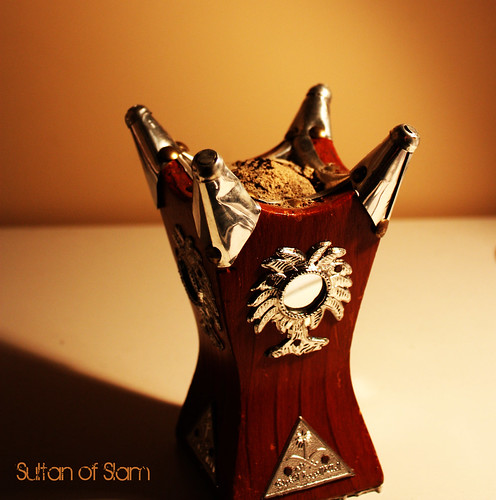
Oud chips and incense are burnt in an incense burner called mabakhir during the holy month of Ramadan, after breaking the daily fasting with a meal and showering, and before the evening prayers at the mosque. It is also incorporated into the Hadj ceremonies and is burnt during Eid.

Burning oud is considered a great honour, and is part of the customs of guest welcoming (when the host can afford it!). Hospitality is a custom that is held in much regard, and is considered a virtue in Arabia and in the Middle East. The hosts share their best commodities with their guests, no matter how rich or poor they are. What began out of necessity for survival in the desert by offering clean water and a feast to break the wonderer’s hunger has evolved into entertaining with more precious commodities such as coffee, sweets and burning the finest and most precious incense the host possesses.

Oud is also used to scent clothing by saturating the garments in agarwood smoke, a custom that interestingly enough is common to both Arabia and Japan.

Grading: Agarwood manufacturers classify agarwood into four distinct grades:
Grade 1 Black/True Agar: mainly exported to Arabia as incense Grade 2 Bantang: mainly exported to Arabia as incense Grade 3 Bhuta or Phuta: sometimes extracted for a superior oil Grade 4 Dhum: used for oil (Source: Cropwatch)

Perfumery:
The Arabs are particularly fond of oud oil, dehn al-oud, which they use as a personal fragrance. Because alcohol is forbidden in Islam, Arabian perfumes are traditionally either essential oils that are worn neat on the skin, or based in an oil carrier.
Agarwood is the most expensive natural essence known in perfumery, and therefore mostly been used by the royalty or nobelty, or wealthy merchants. Agarwood is more often than never used as a single note from a specific country and grade. And less often it is blended with other notes such as rose, sandalwood, musk, ambergris, etc. And as mentioned in the 1st part of the series, it is not uncommon for the oil to be adulterated with lodh oil and several synthetics.

Oud is also used in a lesser extent in Indian perfumery. I have with me a sample of “musk oud attar”, which is a very dark, musky, animalic oud distilled with other secret plant materials into sandalwood oil. It has great tenacity and longevity.

Agarwood is an unusual woody note that is rarely used in perfumery, because of it prohibitive cost. There is an increased interest in agarwood in the past decade, perhaps triggered by the release of M7 by YSL in 2002, which was the first Western commercial perfume to use agarwood as a distinct note. Until than, agarwood oil was mostly used by Arabian perfume companies (i.e.: Ajmal, Arabian Oud, Madini, Rasasi) and the odd niche perfume house (i.e.: Montale’s oud line).

Agarwood is used in luxurious Oriental and woody compositions. It creates a sensual, resinous-animalic or clean-woody warmth and blends well with resins, balsams, spices and precious florals to make outstanding perfumes. A little touch of agarwood can turn an otherwise simple and ordinary scent into a magical phenomenon.

Examples for contemporary perfumes with agarwood:
M7

Oud Abu Dabi

Oud Wood

Arabian Aud (Ayala Moriel) - one of a kind

Click here for more perfumes I've created containing agarwood.

P.s. We will come back later with more insights on oud in perfumery.

Labels: , , , , , , , ,

Monday, March 08, 2010

Decoding Obscure Notes Part IX: Precious Parasites


Gaharu Buaya, originally uploaded by naz1098.

Did you know that the two most prized woodsy perfume and incense materials owe their existence to parasites?

East Indian Sandalwood (Santalum album) is, in fact, a parasitic tree which feeds on neighbouring trees through its roots system. And the most expensive natural raw aromatic in the world, agarwood, smells like nothing special until the tree is injured and becomes infected with parasitic molds and fungi, which causes it to produce a dark resin in the heartwood and inside the roots.

Formation of Agarwood
Agarwood is a resin that develops in several trees from the genus Aquilaria. Several different fungi are associated with the presence of agarwood, including Phaeoacremonium parasitica, but it remains unknown what exactly causes the formation of agarwood. It has been associated with physical injury of the tree, bacterial and fungal infection that cause production of resin, and also is reputed to be more likely found in older trees (between 20-50 years old).

The resinous (meaning infected) Aquilaria heartwood, aka agarwood, is unusual comparing to other woods, because it sinks in water. The Chinese name for it Chén-xīang means exactly that – “wood that sinks”; and the Japanese Jin-Koh means incense that sinks.

Only the resinous wood is called “agarwood” and is valued for incense and essential oil production. There are about 8 out of the 15 of the genus Aquilaria that produce agarwood. Aquilaria agallocha, aka Aquilaria malaccensis is the most highly prized in most places (also called “black agarwood” in Tibet).

The Trees

Agarwood is formed in several indicidual species, all from the Thymelaceae family. The main one know is from the Aquilaria genus, and to a lesser extent Gyrinops, It is very difficult to tell from what species a piece of agarwood was originated from, even with sophisticated technology and expert knowledge. Most of the time, agarwood’s species of origin is recognized by its place of origin, which can indicate what species grow there that form agarwood. For a full list of agarwood forming speices click here.

Aquilaria malaccensis aka A. agallocha is an evergreen tree, about 15-30 meters tall with a trunk up to 1.5-2.5 meters in diameter. It is native to Southeast Asia and is widespread in that region. It grows in Bangladesh, Bhutan, India, Indonesia, Iran, Malaysia, Myanmar, Philippines, Singapore and Thailand. Aquilaria is quite an adaptable species, and grows in many different habitats and altitutdes, including sand, rocky slopes and even near swamps. They grow in areas with average daily temperature of 20-22 degrees C.

Etymology
“Spikenard and saffron, calamus and cinnamon, with all frankincense trees, myrrh and aloes, with all the chief spices.” (Canticles, 4:14).
Agarwood is also referred to in the bible as “ahalot” or “ahalim” and is mentioned in the same breath with myrrh in several books of the bible (including Canticles and Psalms).

Agar is the Hindi name for it, where as in Assam it is called ogoru. In Western literature it is called aloes, aloeswood or eaglewood; in Arabic and Muslim countries where it is most admired, it is called oud, aud, audh gaharu; in Indonesia and Malaysia; and kyara is the name for the highest grade of agar in Japanese – to name just a few of the titles it goes by.

Description of the Scent
Agarwood oils posess a woody, animalic, musty, fungus-like, slightly medicinal, warm, musky scent. Some agarwood oils resemble sandalwood and spikenard, especially ones that are lighter in colour. Darker agarwoods, such as the cultivated agarwood CO2 produced in Assam, India have a scent like no other woody oil, that can be described as intensely animalic, reminiscent of ambergris but stronger and more penetrating, with an underlining note that is sweet and raspberry-like.

As for the incense, which is how agarwood is used more than any other – it varies greatly depending on the quality and resin content. The one agarwood incense that I have experienced was a Japanese incense stick of Kyara, and it was extremely refined and transcended above any other incense experience I’ve had. It was smoldering yet delicate, and brought an immediate sense of peace and depth to my existence. I have 4 little agarwood chips from 4 different places in the world, and some very basic koh-doh incense tools, but I am still waiting for the right moment to burn them. With this feature article, the moment have arrived, and once I have burnt them I promise I will write about each of them here on SmellyBlog.

Harvesting, Sustainability and Ethical Issues
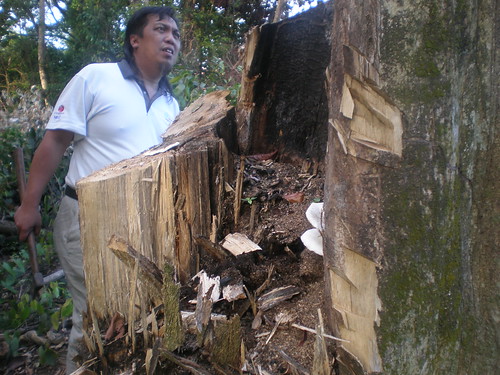
Although only infected trees are odorous and possess potential for monetary value, many uninfected trees are felled and chopped in hopes of finding agarwood within the trunk and roots. This poses a serious danger to the species of Aquilaria in general, and Aquilaraia malaccansis in particular.


Pemilihan Kayu/ Teras Minyak, originally uploaded by azizilajis.

Only 7-10% or wild Aquilaria trees will develop agarwood. There are varying opinions and evidence about relationship between the age of the tree, its size and the yield of agarwood it may offer. Some say that the larger the tree, the higher agarwood content it will have – and that trees should be harvested between ages 20-50 to maximize yield of agrawood. On the other hand, there is evidence that agarwood occurs in trees as young as 3 years of age.

Although there could be some relation between dying trees (indication to that are dry brown leaves, leafless branches and bumps on the trunk and brances), aquilaria trees may show little or no signs of having agarwood within them. The tree has to be felled and split open to discover the precious resinous agarwood within. Unfortunately, this led to over-harvesting of aquillaria and the trees have become an endangered species to various degrees as a result. The (misinformed) belief that agarwood develops in the tree after it is chopped down also did not help in the matter.

In the past 10 years or so, some actions are finally being taken to reduce the risk of agarwood’s extinction, including research, regulations (mostly by CITES - Convention on International Trade in Endangered Species of Wild Fauna and Flora) development of more sustainable harvesting practices, and finally – plantations of aquilaria trees for agarwood production.


inokulasi pokok gaharu, originally uploaded by ahmadkamal.

gaharu subintegra, originally uploaded by ahmadkamal.

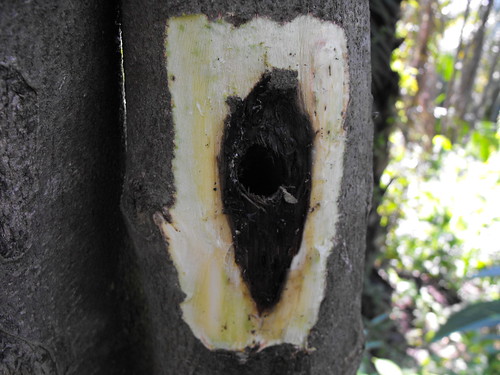
By using new methods of harvesting, agarwood trees can stand and continue living: the tree is injured by making a hole in the bark, and once the agarwood is produced in the tree, it is scooped out so to speak, yet without cutting down the whole tree. Sometimes, a piece of round clay is used to keep the hole ajar so that agarwood can be collected repeatedly in the future (see above photos).


Hand repotting of 4 month old Agarwood saplings, originally uploaded by Plantation Capital.
Sustainable agarwood is also produced in agarwood plantations (especially in Assam, India), where using methods of injuring and infecting the trees with pegs carrying the agarwood inducing fungi and molds, to produce agarwood in the trees at a younger age. Similar methods are also used now in the wild, so at least this avoids unnecessary felling of trees that don’t even bear agarwood.

Forms of Agarwood Available, Grading and Pricing
Agarwood is sold in the wood in several forms, or as an essential oil. The wood can be extracted into either an essential oil or by a CO2 extraction, which is a relatively new method.

The wood is sold in powdered sawdust form, wood chips, wood pieces and to a lesser extent – as whole logs of wood.

The whole wood is mostly in demand in Japan for building private shrines. As an incense material, it has a near guarantee for no adulteration; but it will provide no consistency as some parts of the wood will be more infected than others, and some may not be infected at all. So its use for incense is not so practical for the end consumer.

The wood comes in many different sizes, forms and grades. Wood chips are more common, because they are easier to carry, transport, grade and use by shaving off small pieces for incense burning rituals. Wood chips will be graded based country of origin and their quality, which is based on both resin content and the particular demand within the country they are sold. The price for agarwood is oftern based on rarity rather than quality. So if you intend on buying agarwood, you should really know agarwood well and know what you will be using it for - rather than buy the highest price you can afford.

Another important thing to know when buying agarwood pieces for incense is that the appearance alone is not enough for deciding on the quality; neither is the smell of the wood as it is; it must be burnt as incense to fully evaluate its quality and scent.

Adulteration of the Wood
Agarwood powder is the most prone to adulteration or low quality. Agarwood powder is extremely lower in price comparing to agarwood chips and pieces of wood. This is because it is usually either by product of the agarwood oil manufacturing (i.e. the powder of the wood after it has been distilled and the true agarwood resin has been removed from it); or is simply sawdust from the uninfected Aquilaria. It is mostly used for incense production, as an odour-neutral base for incense sticks and cones.

Agarwood chips aren’t risk-free for adulteration either. According to traders from Mumbai, India “common chip adulterants were ‘lodh’ (possibly Symplocos racemosa) and ‘astrang’ (possibly Mandragora officinalum)”. (see: HEART OF THE MATTER: AGARWOOD USE AND TRADE AND CITES IMPLEMENTATION FOR AQUILARIA MALACCENSIS by Angela Barden, Noorainie Awang Anak, Teresa Mulliken and Michael Song )

Some traders will also mix resinous chips with uninfected wood to increase the weight and their profit.

Other forms of adulteration of wood include impregnating sculptures or beads carved from other woods, with agarwood oil. Aquilaria (the non infected wood) is very soft and difficult to work with, and even more so can be said for agarwood.

Adulteration of the Oil
High quality agarwood oil has a unique scent that cannot be reproduced synthetically, and any effort to do so will be very costly. As mentioned before, there is far more demand for agarwood than there is supply (thes supply is only 40% of the world-wide demand).

Agarwood essential oil is the most expensive essence in the world. Grades vary quite greatly, but it is not uncommon to find agarwood oil sold for $14,000-30,000 per kilogram! All of these factors make agarwood very attractive target for adulteration, mostly with other essential oils that have similar odour profile, i.e.: woody, musty, etc.
“Agarwood oil is adulterated with lodh oil, five or six other chemicals and/or agarwood powder that imparts
the fragrance of agarwood”.
It may also be blended with other natural oils that have some resemblance to agarwood and can extend its aroma (although in some cases the cost for using those is still rather high), including sandalwood, vetiver, spikenard, amyris (West Indian sandalwood), etc.

Next: Religious and cultural significance, medicinal uses, and use of agarwood in incense and perfumery.

Labels: , , , , , , ,

Tuesday, January 12, 2010

Arabian Aud


Arabian Agarwoods, originally uploaded by Ayala Moriel.

It seems like eons since I’ve shared anything here about anything creative going on in the studio. Not that I share everything that I do in my little tiny lab; but honestly, there was nothing to share. I have been avoiding my organ since the summer, except for when replenishing batches of perfumes that sold out. Which was fun, of course, but not interesting enough to write about here.

To be perfectly honest, I’ve been going through what could seem from the outside a “dry spell”. But really was a result of me being over worked and over stressed and intentionally avoiding creativity in my life. I had so much to process and take in, and I had to keep everything in the business as smooth as possible during the busiest season in the year (I literally had no time off for 6 weeks at certain point – unless you count a few hours here and there).

Creating new scents requires a certain degree of tranquility, not to mention concentration and focus. I really find it best to avoid creating anything new. It may seem strange, because in other art forms (music, dance, painting…) the act of creating art is calming and centering on its own. And I usually find that is the case with perfumery as well (to demonstrate this: I can’t even count how many times I had a headache and it disappeared only few minutes after I started working with the oils).

But this time it was different, and I really prefer to create with a clear mind. When traumatic and painful stuff happens in life, associating it with a fragrance will make it forever engrained in one’s olfactory memory. And frankly, I think I can do without that extra reinforcement of memory right now. Some things are best forgotten, or at least left to chance for imprinting their memories on our soulds. At times like that, I think it’s best to stick to fragrances that are comforting and familiar. And that’s pretty much what I was doing.

So back to my lab I am and with gradually increasing thrill, excitement and curiosity. And interestingly enough, my first material to delve deeper into is aquilaria agalocha, aka agarwood, eaglewood, audh, oud, oudh or for simplicity’s sake, in this post I’m going to call it aud.

Aud has such a profound impact on the mind when it’s burned as an incense. It really brings something otherworldly into the room where it is burned. Perhaps there was a reason why I was drawn to it at this point in time. It has an intensity and grace like no other oil.

In this perfume I created just a few days ago, and am wearing on my wrists today, I tried to go all the way with aud, to its most aggressive extremes. As noble as the scent may be, it develops in the wood only after it has been infected with a parasitic fungus. Agarwood collections look like scattered ancestral bones. The wood has hardly any scent on its own in room temperature, but once burned becomes something completely different. A similar effect is created by steam distillation or CO2 extraction. Which goes to show that great things can come out of morbid death and decay…

So, to take agarwood into the extreme, in this first experiment I decided to make it more animalic, a little smoky and as heavy and smoldering as I could possibly can. Agarwood CO2 is the most animalic one I have at the moment, very dark, resinous, almost yeasty, and at the same time a little berry-sweet underneath it all. It’s a sweet wood, instead of a dry wood (cedarwood, for example, takes it all when it comes to dryness). To intensify the animalic aspect, I added costus root absolute, African stone tincture and honey absolue. And to express the incensey, resinous, smoldering characteristics, I used some fossilized amber resin (steam distilled twice from the dust of the amber that is used in jewelry) and labdanum, and also an Indian amber-aud attar. It begins intensely aud with some smoky ambery notes creeping in from benath, and remains that way for a while. The amber and honey take over after a while though and leave a veil of sweetness behind.

Labels: , , , , , ,

Tuesday, January 20, 2009

Purple (p)Rose


Purple rose of Cairo, originally uploaded by ay_caramba_nz.

This perfume was created after exploring Indian roses and exotic attars while watching The Purple Rose of Cairo. The name was selected as a tongue-in-your cheek gesture to fluffy perfume ad-copies and fragrance literature laden with purple patches. Consider this to be the part of the film where the screenwriter converses with its characters while they step out of the silver screen attempting to get a life.

Purple (p)Rose is rosy and exotic. Many essences extracted from plants grown on Indian soil seem to have a certain sweetness, depth and spicy richness. I sometimes wonder if there is curry in the Indian soil that affects the aroma of these plants and make them stand apart from those grown in other countries. The essences I chose are mostly ones that I associate with the colours purple and blue. There is no particular logic behind that notion, it's completely intuitive. There is no way for me to explain why I think champaca smells purple or Buddha wood smells blue. I can only hope you will understand me if you smell them.

The opening notes are rosy with hints of spice and fruit, evolving into a plush floral heart with traditional Indian rose attars of rose and oud, ruh gulab (a traditional Indian distillation of rose), red champaca, blue lotus and blue waterlily to compliment the purple theme. And finally, deep woody notes of sandal, oud and Buddha wood, precious and sublime encompass all and invite meditation.

Top notes: Chinese Five Spice, Magnolia Lily, Cassis

Heart notes: Indian Summer Rose Attar, Ruh Gulab, Red Champaca, Blue Lotus, Blue Water Lily

Base notes: Agarwood, Amber Oudh Attar, Bakul Attar, Buddha wood, Sandalwood

Now available via Etsy under the One-of-a-Kind Perfumes section.


47-Purple Rose Of Cairo.JPG, originally uploaded by Tania Conrad.

Labels: , , , , , , ,

Saturday, December 13, 2008

Snowy Night


snowy night, originally uploaded by Sasakei.

It's snowing for the first time this year, and I'm snuggling up in bed snuggled up in my cozy pyjamas and perfumed with my latest version of The Purple Dress (with champaca, henna flower, broom and oud) and wrapped in Kyara incense smoke.

What would you wear when it first snows? Share your thoughts below and enter to win a sample of The Purple Dress.

Labels: , , , , , , , ,

Sunday, April 22, 2007

Oud Omani


man with falcon, originally uploaded by dirkcush.

Strongly medicinal and camphoreous at first, so much that I fondly recall pharmacies and clinics from my childhood where I often visited as little bug-bitten girl to be treated with a cooling calamine lotion, ahhh.... Yet, what is at first an animalic-medicinal agarwood evolves into an elusive musk with raspberry undertones that are (not surprisingly) far more interesting and tasteful than Western mass produced oud interpretation, M7. It than develops some green undertones, reminiscent of spikenard and vetiver, but not quite. Smooth notes of rose appear, very subtle. Although it is not as agarwoody as I’d like it to be (being familiar with the raw materials), it surely radiates the exquisite natural luxury of agarwood, even though with the help of a few synthetics. The dry down of the oud from Oman is incensey, woody, musky, clean and masculine, very much like the smoke of a high quality sandalwood incense sticks.


, originally uploaded by ***•***•***.

Labels: , , , , , , ,

Oud Abu Dabi


Turning now her breast toward her crying babe, She did not move her bottom, pressed beneath me.
Imru’l Qais (d. c. 535)

Gentle and delicate, roses weave in and out like floating silk scarves of mysterious dancers. It dries down to the most beautiful woody powdery dry down, resembling high quality sandalwood incense in a Buddhist temple. Overall, it's a lovely soft woody-floral, with dewy rose playing an important role (not unlike how it is casted for the Al Mesk Abyad). I only wish the rose did not smell so artificial in this one, it really takes away from my enjoyment at first. But after the dry down it is a soft and smooth agarwood and musk for the most part - almost as if the formula is a hybrid between Al Mesk Abyad and Oud Omani.

Labels: , , , , , ,