Tuesday, June 03, 2014

Seven Fragrant White Flowers for Shavuot


Shavuot is beginning this evening, and to celebrate, I've put together a bouquet of 7 white flowers that are currently in bloom. Wearing white is a Shavuot tradition, and so is wearing wreaths of flowers on the head. When I was a little girl, this was the time of the year when fragrant roses will be in full bloom, and the children lucky enough to grow them in their garden will have a flower or two of deep, wine-coloured burgundy rose in their baskets of first fruit - alongside apricots and green almonds. I am grown up enough now to own up to it and say I was deeply jealous of their baskets, and couldn't keep my nose away from it. This collection of seven flowers will not include white rose (or jasmine, for that matter) because I would like to make room for less known white flowers and hope that you find this post inspiring and alluring.

1. White Peony:

I find the white variety to be more well-rounded. White peonies smell a little more heady  than the pink and a tad jasmine-y but still also peppery and fresh. There is a strong resemblance to lily of the valley, and also there's a hint of hyacinth's heady floral and sharp green-onion-y notes. The flowers fills the room with their beautiful scent for a full week after being brought home from the florist. The pink ones are a bit of a hit-and-miss. Some smell rosy and with a hint of spicy carnation note; others are more green and dewy; and some smell funky, like rotten vegetables...

There is no shortage of peony-themed fragrances, but non has captured my nose as of yet. If you have any recommendations, I'll be happy to try them!

2. Choisya "Aztec Pearl" (aka Mexican Mock Orange)

Smells more like heliotropin than orange blossom to me, but is related to the same family (Rutaceae). The flowers have a powdery-sweet aroma with hints of methyl anthranilate. Very soft and alluring. I only know of one fragrance that is centred around it - Choisya candle by Dyptique.

3. Black Locust (Robinia pseudoacacia): 


The black locust tree is native to the Southeastern United States, but have found its way to many a gardens across the world, where it has become naturalized (and in some cases invasive) in temperate North America, Europe, South Africa, Asia. The origin of the name: Because of their similar fruit shape, Jesuit missionaries confused it with the carob tree Carob Tree (Ceratonia siliqua). 

The flowers have a havenly sweet-pea aroma mingled with the scent of intensified orange blossom. The methyl anthranilate aspect really coming through like a candy from the gods in this tree flower from Fabaceae family. The flowers are edible, having a sweet and aromatic flavour, but the fruit is not (though some say the seeds are edible too). Try using the flowers in a sugar syrup for desserts, or crystallize them in a similar way that rose and violet petals are treated. The entire flower clustered are dipped in batter and deepfried into fritters

I'm currently experimenting with some black locust syrup and tinctures recipes, and will report to you once they've rendered successful (which they are bound to be! The syrup is already tasting amazing halfway through the maceration process).

4. White Carnation (Dianthus): 

Dianthus seems to be the flower of the season, popping up in many gardens in the West End this year more than I've ever seen it before. I finally planted my own two Dianthus "Coconut Surprise" plants in my balcony's forelorn planter. They will only go till the end of fall, and I plan to thoroughly enjoy them!

I've gone into much detail about the scent of carnation. The white variety is what's mostly used for carnation absolute production for perfumery. The flowers have a beautiful, sweet-warm and soft-powdery scent and I can't help myself but get on my knees to smell everyone I meet on my walks in the neighbourhood.

Favourite carnation perfumes: InCarnation, Bellodgia, 

5. Philadelphium:


To my nose, Philadelphium smells like fedjoia - fruity, exotic, edible and unusual.
Is is also known as Mock Orange, but is a different plant than Choisya, and smells completely different. 

6. White Magnolia (Magnolia × wieseneri):


This particular magnolia has a magical scent. According to Wikipedia: 
"Its most notable feature is the remarkable fragrance of the ivory-coloured flowers, which has been likened to pineapples and seen adjectives such as "ethereal", "spicy" and "aromatic" used". It significantly changes its scent throughout the day, smelling like a dewy jasmine-tea in the evening, and developing a more fruity-aldehydic and lactonic character during the day, reminiscent of peach (aldehyde C-14) and a fatty, oily-skin-like scent (aldehyde C-13) during the day and once the flower is "overripe".

Favourite magnolia perfumes: New Orleans, Opium Fleur de Shanghai


7. White Lilac:

White lilac has more indole than the purple or pink ones, giving them a more perfumey character. Additionally, lilacs have the scent of powder, hints of green fig and cucumber, and in many cases also a rather dominant styrene presence.

Favourite lilac perfumes: Ineke's After My Own Heart and Olivia Giacobetti's En Passant (for Frederic Malle Editions de Parfum). 

If you want to celebrate Shavuot with the traditional desserts, here are my recipes for the perfect blintzes and best ever cheesecake!


Labels: , , , , , , , , , , , ,

Monday, April 30, 2012

Monkey Monday: Forbidden Lilacs

Lilacs by Ayala Moriel
Lilacs, a photo by Ayala Moriel on Flickr.

As I was strolling leisurely down Bute street towards Sunset Beach last night, I noticed that one of the lilac bushes was beginning to bloom. The buds haven't opened yet, but I could not suppress my curiousity and had to sniff them out and see if their scent has began to develop.
Before I could even figure what came first - the flower or the fragrance, I heard a woman yelling from a balcony in that building. I assured my daughter that surely this woman must be yelling at some dog that's ruining her patio garden; but she made it very clear that she was mad at me for "picking the flowers". I doubt that this bush even technically belongs to her, being one of the many trees and plants along the sidewalk (Vancouver does amazing job with gardening everywhere); but nevertheless I told her I was only smelling them. Which seemed to make her even more upset. Apparently, she's not willing to even share the scent of that lilac (if it will ever have any).

So - our Monkey Monday discussion topic today is this: have you ever been led by your nose into trouble?

And among those of you who comment, there will be a draw for Lys Méditerranée decant.

Labels: ,

Wednesday, June 08, 2011

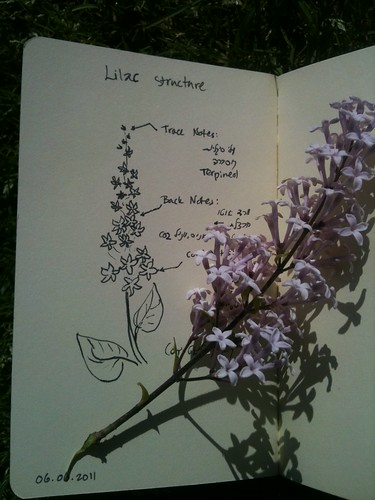
Lilac Structure

Lilac Structure by Ayala Moriel
Lilac Structure, a photo by Ayala Moriel on Flickr.

Enjoying the very last blossoms of lilacs around town for me thinking, yet again, about structure. Trying to build a lilac perfume from natural materials only is probably impossible using complex aromatics such as direct extractions and distillations (i.e.: essential oils, absolutes, etc.). If I were to use isolates, this would be a lot easier - terpineol is the main molecule that makes lilac smell like lilac, and the other notes serve as a backdrop to enrich that characteristics. According to Poucher's profiling of lilac, it only takes terpineol, plus an artificial lily and heliotrope bases a touch of rose and jasmine essences to create a true lilac scent. He uses the word "back notes" to describe the role of heliotrope and rose and lily in the fresh lilac flower scent. And this got me thinking about the lilac structure. It can be illustrated like the flower itself - with the core notes, or the main ones being those that give it the character (which I drew on the very bottom part - the larger blossoms on the lilac stems), with the "back notes" - i.e. the nuances that give the lilac its richness, acting like a backdrop for the most dominant notes; and lastly - the trace notes, which are the unopened buds on the lilac stem.

Do not confuse between top notes, heart notes and base notes and the trace notes, back notes and core notes. Some of the core notes can be base, some can be heart and some can be top notes. It has nothing to do with volatility, but with the olfactory structure of the perfume, of what's dominant and determines the character, and what's just an added nuance. As in the case of lilac - while there are three main "floral bases" in the back notes, the heliotrope, for example, will require heliotropin (a base note) as well as some anise (a top note).

It's quite abstract and conceptual to think about structure in perfumery, and visuals do help. What I find most fascinating, is how the shapes in the natural world correspond so well with the other chracteristics of the plant. It's difficult to me to describe the "shape" of the smell of lilac, but the shape flower itself makes it self-explanatory. The smell of lilac is as fluffy, delicate, airy, heady (pointing upwards like the clusters of flowers) and with some main characteristics notes backed up by olfactory nuances that play supporting roles in this lilac show.

Labels: , ,

Sunday, May 22, 2011

White Spring at Lighthouse Park

I went for a hike today at Lighthouse Park, and stumbled upon some beautiful white flowers, not all of which were fragrant, but all the same beautiful:

The white lilacs were on the way to the park on Beacon Lane. Crisp looking and befitting a bridal bouquet in appearance alone... Their scent is just a tad cleaner and less sweet than the purple lilac.

Within the park, blooming tall shrubs of what looks like a wild pear judging by the flowers and leaves, but is more likely to be Saskatoon (which will turn into not too small-apple shaped berries later in the summer).

Red elderberry's flowers (aka elderflowers) are described in Plants of Coastal British Columbia as "White to creamy, small, with a strong, unpleasant odour; muberous, in a rounded or pyramidical parasol-like cluster". Admittedly, they did not smell all that bad to me... Not any worse than blackcurrants. But my nose is more tolerant than my taste buds, and I'm still not quite sure if I like elderflower cordial or not.

And last but not least, the pristine lily of the valley blooming by the rocks in the lighthouse keeper's garden. A feast to the senses and a pleasant surprise to find them in the forest by the sea!

Labels: , , , , , , ,

Wednesday, September 30, 2009

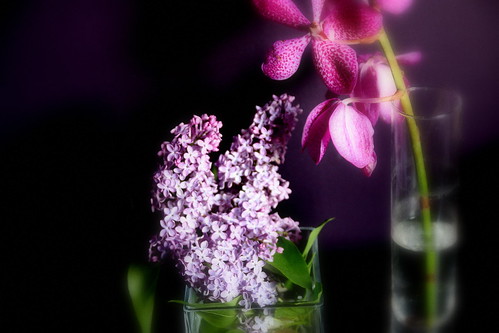
Lilacs & Orchids


The name “Madagascar” brings to mind notes such as ylang ylang, geranium and vanilla (the only real orchid used in perfumery). And so, I was expecting vanilla from Lisa Hoffman's Madagascar Orchid. Instead, I got lilac.

Nestled in a pebbled-green, soft leather travel pouch were four little roll-on bottles with a golden cap. The “Variations” took me by surprise when each one of the four bottles turned out to contain a different scent – each one a variation on the theme, made to fit a certain moment during the day: morning, daytime, evening and bedtime. Interesting concept, with some practical implications: The nose does get tired if you wear the exact same fragrance all day, and the olfactory bulb does goes through different degrees of sensitivity throughout the day. It is also particularly fun for perfumistas, who enjoy exercising their refined sense of smell by comparing the subtleties between each variation. And lastly, it is definitely much cleverer than the flankers we see popping out only several months after the “original” scent comes out (usually it won’t be original at all).

The morning variation would be light and not overpowering, as to not overwhelm you before you had your coffee; the daytime variation seems quite strong, and I have a feeling it is going to come handy as a pick-me-up scent when the energy goes down in the afternoon; the evening is the most sultry and rich of the four; and lastly the bedtime variation is soft and a little powdery, to help you wind-down and drift into sleep.

The Madagascar Orchid Morning variation is quite soapy, but also dewy and a little crisp, like what you’d smell on a cluster of lilacs early in the morning, with hints of crushed green leaves in the garden.

The Daytime variation is a little more full-bodied, but still within the fresh light floral realm. The lilac note in here is quite pronounced but with a bit of powder and sweet notes as a backdrop. It took me a while to figure it out, but it really did remind me of the lilac-scented deodorant I got when traveling in Quebec 12 years ago, which brought me some fond memories.

The Bedtime variation is more delicate but my least favourite. It’s not as floral, and a even more powdery than the previous two. I think I can smell lavender in there.

The Evening variation is distinctively different, with warm, sweet notes of incense crawling from beneath. It was the first one I gravitated towards, and it’s the only one in the collection that really could remind me of an exotic orchid. It does not have much of the lilac as in the other ones, but instead, has a scent reminiscent of the East Indian “Night Queen” perfume, and with trails of sweet incense smoke swirling around it.

Personally, I enjoyed the Evening variation more then the rest, which is not surprising at all considering that I usually gravitate towards the heavier scents. The contrast between the smoky incense and the heady flowers is mediated by a tad of sweetness (perhaps vanilla) yet never sugary sweet. Like I said the other day – it makes for a perfect fall floral scent.

Orchids are usually "fantasy florals" - a composition made of several different notes (natural and/or synthetic). Sometimes they are completely "made up" from the perfumer's imaginations; other times they are captured using headspace technique from exotic orchids in faraway lands. In other words - what perfumers call "orchid" could smell like anything or like nothing else. This particular orchid perfume is both exotic and intoxicating and whether it smells like a particular orchid or like something familiar from my daily life is not important; but the fact that it creates the sensation of a fragrant blooming orchid.

The "official" notes for the Madagascar Orchid collection are: sheer jasmine, ylang dew, mimosa mood, and pink peony. Another interesting thing to note is the medium for this collection: the base for these roll-on perfumes is made of a mixture of nut and seed oils such as sesame seed oil, rice bran oil, macademia nut oil, brazil nut oil, acai pulp oil, jojoba esters, squalane oil and vitamin E.

The Variations series come in a leather wallet, or you can get a refill. You can purchase them directly from the Lisa Hoffman website, and also enjoy the following discounts offered to SmellyBlog readers:

Effective until October 15th: enter LHB4DC to receive a 35% discount on all orders.

And until the end of the month (October 31st), SmellyBlog readers can enjoy a 15% discount on all Lisa Hoffman products with the coupon code SMELLYBLOG.

Labels: , , , , , ,

Wednesday, May 07, 2008

Mental Notes: Nuts on Matcha and Lilacs

Today (or is it already yesterday?) is an exotic nutty day - I was wearing Vetiver Tonka, which had that unique sesame seed note roasting in the background.
Surprisingly, the traditional (unsweetened) matcha I had late this afternoon at Steeps Tea was nutty and smelled like white chocolate or cocoa butter.
On the way back home this evening after belly dancing I met two lilac bushes, one in full bloom with tiny flowers and one with large ones but not as fragrant or as abundant quite yet. The small one, planted in a bit pot on the patio of a restaurant on Davie street, was so fragrant it was just like perfume on a bush.
It reminded me of how strange it was to compare Diorissimo just a few days ago with the real living flowers. Side by side, they almost had nothing common. At least it wasn't all that obvious with the parfum concentration. Which goes to show that Diorissimo is a perfume, not just a lily of the valley note.

Labels: , ,

Wednesday, June 13, 2007

Lilac


Lilac, originally uploaded by Ayala Moriel.

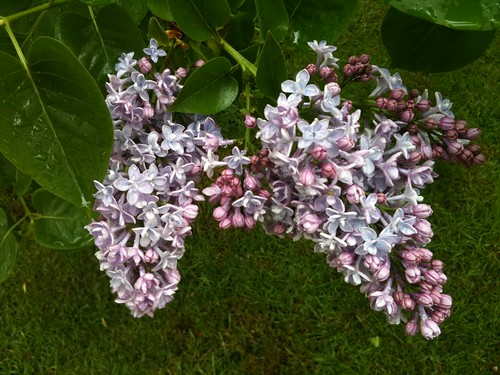
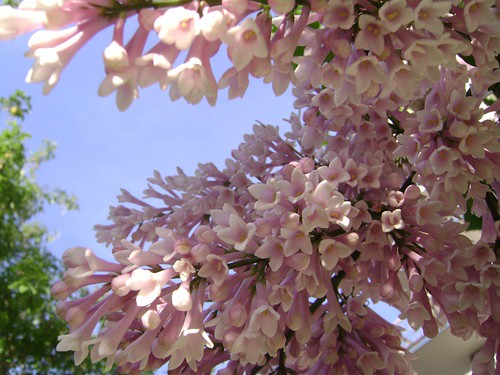
There are so many different lilacs here. Different colours, different sizes of clusters. Maybe this particular one isn’t exactly lilac either. But it sure smells like one. And against the pale blue sky, it is starting to become a symbol of summer for me. In a cheerful way, and without all the misty, dewy and a bit melancholy aspects that lilac can sometimes have on me.

Labels: , , , ,

Saturday, April 14, 2007

After My Own Heart

I spent the weekend in Jerusalem, and on my Friday’s twilight stroll, I found a bush of lilac in full bloom. The scent of fresh lilacs is dreamy yet also awakening with its subtle green twig nuances. The delicate aroma of the lilac branch I picked ealier, as well as my reunion with my lilac-lover friend Zohar made me crave a spritz of Ineke’s After My Own Heart.

Ineke’s perfumes, unlike their longish titles, are minimalist and calculated. The lilac-bouquet named After My Own Heart is an alphabetized representation of the emotion of longing and romance: a burst of lilac flowers, twigs and all, softly brushing against a blushing cheek in an anticipation for caressing kiss. A promise of love, the buds of passion invoked by hints of indole (I detect distant jasmine and cassie here...) and the luscious juice dripping off freshly picked raspberries. As the crushed twigs and rubbed petals lose their freshness, they make room for rosy and powdery accords, gradually sweetening into a dry out of musk, vanilla and heliotrope.

Lilac perfumes, and particularly ones that capture the imagination as well as the scent of these delicate flowers are sparse and few. Lilac absolute, if it can at all be obtained, is not at all comparable to that of the fresh flowers. Therefore lilac perfumes relay heavily on the use of synthetic compounds that reconstruct the aroma of the fresh living flowers, usually by the means of the headspace technique*. The challenge with lilac as with other flowers that don’t yield themselves well to distillation is to create a genuine impression of the flower that does not feel too artificial and imposed. I’ve smelled this happen with Olivia Giacobettie’s En Passant, where the lilac is chilling, powdery and reminiscent of the blooming twigs and crushed leaves on a foggy day. Ineke Ruhland’s After My Own Heart gives lilac a different interpretation, less abstract and aloof than En Passant. It’s a romantic, dreamy lilac, creating a fleeting yet sensual presence of petals, powder, fruit and musk.

I'd like to conclude with the "transcript" of the little poem in the image above (from Ineke's website):

After and before
Today and tomorrow
Sand becoming a wave
What was it I saw at the top of the world
as I fell asleep last night?
I tried putting lilacs in your dreams
You smiled in your sleep
I hear your words like the wind
whispering in my ear
the most enchanting words
after my own heart

* According to Bojensen.net, nowadays, lilac is often produced with the headspace technique. (E)-ocimene is the most dominant in the makeup of the scent, yet it is the furanoid terpene aldehyde , AKA lilac aldehyde, benzyl methyl ether,
1,4-dimethoxybenzene (hydroquinone dimethyl ether) and indole which give lilac is characteristic odour. The other important odorants which give lilac its characteristic smell. Benzyl methyl ether has an intense fruity-etheral scent which is reminiscent of the top notes of ylang ylang. Lilac headspace also contains minute amounts of anisaldehyde, 8-oxolinalool, cinnamic alcohol and elemicin.

** To read another review of After My Own Heart, visit Legerdenez

Labels: , , , ,

Friday, May 19, 2006

While Passing…


Whale Watch, originally uploaded by Weffie.

Things you may find while passing might be the least expected. I passed through to smell the lilacs of En Passant, and in a short snatch, a-la the chess maneuver by the same name, I found myself searching for whales on a misty day on the Sait Laurent river… Unsuccessfully, needless to say, but enjoying the fjords and the moist mist…
The heady, innocent and slightly powdery spring-like scent of white lilac quickly leads my nose to the subtly fragrant branches and stems bearing blossom-vines. These transform into an olfactory green fig leaf scent, and than in a split of a second you find out that you just jumped, head first, into a chilly ocean – smelling the fresh air of the ocean breeze, with its slight saltiness, and the clean, fine mist meeting your face as you watch for whales on the fast-loating boat…

With notes of white lilac, cucumber and wheat, Olivia Giacobetti has created an abstract lilac perfume that is more of a subjective interpretation of the flower rather than an effort to re-create the scent of the fresh blossom. Its ozone and marine cucumber notes are not my personal favourite and the wheat adds to a certain flour-y powdery yet green nuance that is nevertheless interesting and original on its own. However, the result of the final drydown is surprisingly disappointing in its ozonic-oceanism and its reference to l’Eau d’Issey of all perfumes.

Top notes: White Lilac
Heart notes: Fig, Cucumber
Base notes: Water, Wheat, Violet Leaf

Labels: , , , , ,

Monday, May 15, 2006

Lost Lilacs

It is sad when a thing of beauty is lost. But the absence of a beauty makes it even more desirable and increases its esteem in our eyes. And so, just as the lilac blooms for only a short period of time and do not yield its lovely fragrance to any method of extraction – Mystic Lilac, one of my favourites of all floral natural perfumes has disappeared since its creator has pulled his line out of the market and went on to pursue other fragrant ambitions. Maybe he will read this post and change his mind? I sure hope so. And if this review intrigues you enough you may be my guest and bug him via his website to put his perfumes back on the shelf.

Sublime, delicate and with a seductive breath of Spring, Mystic Lilac brings to us the joy of inhaling Lilac bushes in full bloom – the twigs, the leaves, and the Spring air warming to the sunny skies.
This is a simple yet interesting rendition of Lilac – that has depth and dimension as well as a hint of mystery…
Starts off with quite distinct Ylang-Ylang and Violet Leaf accord, which establishes the green-floral, powdery-sensual theme. In the background, precious Blue Lotus, Jasmine and Tuberose create a pulsating Lilac effect that is fully established once arriving at the dry down stage while Linden Blossom adds the hint of woodiness to the composition. Powdery, green and with an underlining playful sensuality, Mystic Lilac has immediately captured my heart.

Inspired by the fresh Spring blooming lilac bushes in Michigan, the talented perfumer created this phenomenal all-natural lilac perfume that is a true floral delight. Capturing the sublime and delicate essence of fresh lilac is near to impossible when using only natural materials, and Lilac is more often replicated in the lab with synthetic aroma chemicals. Mystic Lilac may not replicate lilac like most synthetics do (which usually I find overwhelmingly heady and powdery to the point of being cloying, despite their lilac loveliness), but it does create a Lilac impression throughout its existence.

Top notes: Ylang Ylang, Blue Lotus, Violet Leaf
Heart notes: Jasmine Grandiflorum, Linden Blossom
Base notes: Tuberose

Labels: , , , , , ,