Monday, September 13, 2010

Olfactory Brief vs. Marketing Brief


There's a huge different between the two... Unfortunately, the latter has far greater influence on today's perfume industry.

Olfactory brief actually refers to the true olfactory vision. It's similar to giving a filmmaker a story, and asking him to make a film based on that. There are many steps involved in the process, and the result will be a very personal interpretation of the perfume, that reflect the story but also the filmmaker's style, vision and aesthetics (just as an example: compare the Tim Burton's "Charlie and the Chocolate Factory" to the original film from 1971). Same story, but completely different experience, mood, visuals, etc. Likewise, if the same olfactory brief (for example: a perfume inspired by the moonlight) will be given to two different perfumers - the result will be significantly different. One perfumer may choose to create a very bright, white floral perfume, associating the moon with night blooming flowers such as jasmine, tuberose, etc. While the other perfumer may associate the moon with darker lore and myths related to werewolves and such, and create something that smells entirely different (I can't even decide yet what that would be!). An olfactory or creative brief can be very minimal (as the one I presented earlier - the moonlight is a very broad brief) or very elaborate and specific (i.e.: glittering light of a full moon falling on the silvery dry summer grass blowing in the wind of the savannah; or: shadowing clouds pass over the full moon as the lonely wolves are howling from the top of the cliff over the dark thick forest).

Marketing briefs, however, relate primarily to how the perfume is going to be presented to the public in order to sell it to a target audience. The marketing brief addresses rather dry topics such as the target audience (age group, buying power, gender, ethnicity, country or region, etc.), and also less dry but nevertheless very practical points such as packaging size, shape and colour, bottle design, and which face of a certain influential celebrity or a model will be endorsing the perfume and convincing as many crowds as possible to buy it.

While the marketing brief is important to an extent (if any company or independent perfumer wants to survive this competitive environment and continue to produce perfumes, they must have something that brings in enough cash to create anything at all - artsy or not). The reason why the life is being sucked out of the art of perfumery, and so many perfumes smell the same, is because they start from marketing briefs, and not from creative or olfactory briefs. And most marketing briefs look like either one of the following:
"X perfume will accommodate as many section of the population as possible"
"Y perfume will appeal to the teens and tweens with nothing better to do with their lives but to smell like a fruit punch with some amber and flowers thrown in to create the illusion of sophistication and luxce"
"Z perfume is sexy, but fresh; unobtrusive, but easily noticeable; modern and not too flowery, trendy and fun, and will be sold for only $32.99 at your local drugstore so that every other guy and his niece will be able to afford it for themselves or as a gift".

And than we're surprised that most of new perfumes are packed with fake fruit notes & vague florals, underlined with imitation amber, synthetic musk and pretend-woods?!
(Oops, I think I just came up with another marketing brief...!).
I think you get my point...

Labels: , , , , ,

Wednesday, December 26, 2007

Market Saturation

Are niche lines nothing but a very expensive advertisement? The Wall Street Journal examines the phenomenon of the increasing number of niche lines and the real motives behind them. I think this quote from L'Oreal about the Armani Privee line pretty much sums it up:

"(...)the scent remains unprofitable three years after its launch. French cosmetics company L'Oréal SA, which makes the perfume, says it's sticking to the scent because it hopes the cachet around it will stoke interest in Armani's more mass-market fragrances".

I find it utterly disturbing, yet not particularly surprising, to learn that the motive behind the release of such high-end lines is not to make beautiful perfumes for the sake of the art, and the audience who will enjoy them - but simply promoting those many cookie-cutter fragrances that are released in an alarming rate on a nearly weekly basis.

No wonder why the consumers are becoming more and more glacee towards new releases, including those supposedly exciting exclusive lines. There is hardly any soul left in the business. And this obviously comes across and translates itself into dollars. Maybe there is such thing as karma after all.

P.s. Thanks for The Scented Salamander for the link!

Labels: ,

Friday, August 17, 2007

Signatures, Branding, Bespoke and Bullshit


The Name Tree, originally uploaded by Chris.Thomson.

I overheard a typical little conversation in a supermarket between to cashiers. These two ladies were talking between them about shopping for clothes and one lady said where she usually buys her clothes, and how much she loves Ralph Lauren clothes. “I just love the way he cuts his clothes!” she said. “they just always fit me perfectly”. If I was a time traveler coming from the 18th century, I would have thought she knew Mr. Ralph Lauren as her personal tailor, making her clothes to fit her particular shape. But since I’m a time traveler who’s been stuck in the 21st century for quite a while, I happen to know that Ralph Lauren is no longer a person, neither a talented fashion designer, but a brand name representing hundreds of designers that need to put together their new cuts every season, and make sure they come back from the factories in China in time to fill up stores worldwide for the next season. Ralph Lauren himself will probably never meet most of the people that he makes his clothes for.

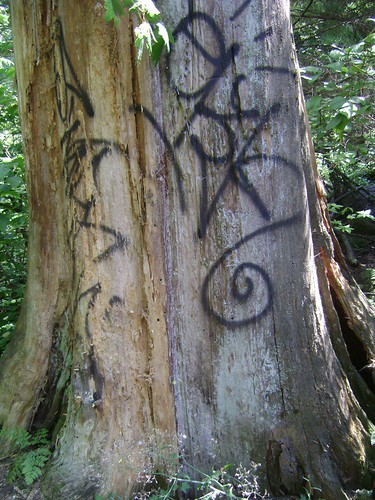
Humans leave signatures on trees, bus posts, walls, rocks – you name it. It’s like saying “Think about me because I’ve been here. Even if you don’t have a clue who I am. Even if you think about me only for a split second”.

Leaving a signature behind to mark our creation is another natural thing to do, but just a little more evolved. It means “this piece of art that you are enjoying or disenjoing right now is all because of me. I have become a part of your life now”.

When the same thing is done and the name is familiar, such as with a well-known craftsperson (i.e.: fashion designer), the name means “See how well I can do this? You sure will be able to use it to the max”.

Ever since the industrial revolution, things have been moving faster, and the role of the signature has changed. It has become a tag, and a part of branding. The tags are printed, engraved or embroidered by the billions and no longer represent a particular person who made the product – but rather, the idea that someone that you know and can trust made it even though they didn’t.

When it comes to perfume, we see the same thing: until very recently, the role of the perfumer was very silent and hidden. Perfumes were released under different brands or people, but in fact were designed by one of the 5 or 6 major fragrance & flavour corporations that rule the industry world wide. Lately this is changing a bit in the sense that we know more about who the designer of the fragrance is. What we don’t know, is how much creative freedom they had versus how much control the corporation they are working for has over the final decision of what we smell on the shelf.

And than there are celebrity perfumes: it is interesting to see how many fragrances are created just to remind us that someone exists. No matter how marginal is their effect on our life, we have to think about them for a split second when we see a new celebrity perfume launched. Oops, I’ve just missed one that just came out two seconds ago… Is it really a celebrity’s favourite scent? Perhaps. But perhaps it is their favourite because it inflates their bank account really fast and helps to steer away the attention of their recently not so great reputation over the tabloids. Note: if you admire a celebrity or love a celebrity scent, take my words with grain of salt, and remember: the main place where I get to “know” these celebrities is in the drugstores: in the beauty section first (their fragrance and ads, where they look stunning and magical), and than when I’m in the checkout, seeing their cellulite/drug abuse shots and/or fighting with their ex…).


Name on the Tree - Graffitti in Nature, originally uploaded by Ayala Moriel.

In many ways, bespoke is anti-branding. What I do is the exact opposite of celebrity perfumes: I create bespoke perfumes for individuals. I believe you and me and the neighbour next door deserve to have the best perfume they want. I feel that your life is fascinating and magical, and that you are very interesting even if you don’t happen to show your face on the tabloids every other day. I feel that what makes us unique can be reflected with a personal scent, and I really enjoy engaging my clients in the creative process of perfume making. When I just started, I insisted for a long time of not using my name for my company to avoid such kind of branding. I called it “Quinta Essentia”, to reflect the process of creating the perfumes – distilling the essences from the plant, and than combining essences together in such way as to portray ones quintessential personality and spiritual aspects in the form of perfume. Only at a later time (about a year ago), I let go of that name and gave in to using my own name, signing on my perfumes so to speak, but also reflecting the very personal connection I have with my clients in the process of creating these signature scents.

A signature perfume will never be a best seller (because it will be sold to only one person, you!). It will be an olfactory portrayal of your dreams and your innermost nature, all distilled, refined and than married in an alchemical process that captures the total essence of you

Labels: , , , , ,

Sunday, August 12, 2007

There are Signs that Green is Back

After a long, long, long period of brain-numbing fruity florals and suffocating gourmands, there are signs that indeed, green is getting back into fashion, fragrance wise.

And while this change in trends is most welcome amongst those of us who either despise fruity florals or simply are tired of cookie cutter fragrances that seem to be the imitation of an imitation of an imitation of something that seemed to be cutting edge or just fun 10 or 15 years ago; there is something a bit worrying about the way greens might be coming back.

The reason for my less than cheerful attitude to this much-anticipated change of course is two-fold:
1) the gradual extinction of certain natural essences that were utilized in classic green perfumes of yesteryear. Namely oakmoss. But naturals in general are becoming a rarity in mainstream perfumes (which makes perfect sense when thinking of the vast quantities of jus produced every year; we simly don’t have enough land on this planet to produce enough natural oils to be a substantial part of all the mass –marketed perfume launched every other day.
2) Judging by the recent green releases (mostly coming out of niche lines first, and it seems that gradually, mainstream perfumes will pick up on the hint and adapt the trend), they offer nothing new. Nothing that we haven’t smelled before (except that its coming from a different or a new brand). Two of the Chanel Les Exclusifs (28 La Pausa and Bel Respiro). The names as well as the compositions are winking quite suggestively at past successes and achievements (either olfactory or fashion), which may indicate lack of finding inspiration in the present time.

Nowadays, it is a challenge to smell a scent without prejudices: the perfume’s name, brand, packaging, colour, advertising campaign, not to mention the anticipation of a fragrance all over fragrance boards and blogs create expectations not only as to the quality of the scent but also how it actually smells. Thes factors all have an impact on what you actually smell in a new fragrance, as those expectations are difficult to block out.

With Kelly Calèche, the expectations went all the way from complete dismissal (pink jus, named after a bag), to a peaked interest once seeing the ad (now, that looks intriguing!) but I wasn’t holding my breath for it. When I passed by the Hermes boutique on Wednesday, I checked in and found it there. It was neither pink nor leathery. It was a green, dry iris with very little to remind one of leather if at all. It starts with an off-putting note that immediately reminded me of Rose Ikebana (which I’m not capable of wearing at all – the combination of berries, greens and rose is nauseating to me, and even more so ever since I overdosed on curried mango pickle in my avocado sandwich one day while wearing l’Ombre Dans l’Eau…). Thankfully, the sharp berry and green phase is short-lived, and is replaced by a fresh, citrus green accord, which quickly develops into a powdery rose and orris body notes. With a dry undercurrent (the leather?) it is not unlike No. 19. After all, pairing greens with leather is not a new idea (No. 19, Ivoire). Neither is the green perfume with orris and rose at the centre. For a moment I get a peppery dry whiff reminiscent of the tea-tinged Osmanthe Yunnan. Overall, Kelly Calèche wears like a sheer veil rather than a leather whip. It’s very well mannered, cool even, elegant in a selective and luxurious style, very much like the public image of Grace Kelly who inspired the bag which inspired the perfume’s name. Would I have been more impressed if the perfume would have been called “making soles in angel leather"? I won’t be able to say now, because it is named after a leather bag. A well made bag, but nothing that inspired emotion in me. I suppose I would have been more likely to appreciate its etheral greenness if it had a name and an image more fitting to what it actually smells like. Just like Bel Respiro and 28 La Pausa, the uninspiring name takes away from the value of the fragrance on its own.
Top notes: Grapefruit, Cassis, Pepper
Heart notes: Rose, Iris

Base notes: Leather
, Cedar, Labdanum

Note that although mimosa and tuberose are listed, I can barely smell them if at all. The base is dry, cedary almost, though not quite leathery. I smell the faintest hint of labdanum there too, without the base becoming sweet by any means.

To read other reviews of Kelly Calèche, visit:
Now Smell This
The Perfume Shrine
Aromascope

* Image of green Kelly bag borrowed from: http://www.chrisabraham.com/

Labels: , , , , , , , ,

Thursday, April 05, 2007

Interesting Read: Aftel and Laudamiel featured in Flare

Click here to download two PDF pages from Flare's interview with Natural Perfumer Mandy Aftel and IFF Perfumer Chritopher Laudamiel.
The article presents two different directions in Modern Perfumery. A must read for you!

P.s. It comes in two pages that need to be downloaded one after the other.

Labels: , , , ,

Tuesday, March 06, 2007

Industry Trends: The Future of Perfumery


Those of you who followed closely the recent developments of Cropwatch’s petition and actions to restrain IFRA’s threats on the use of natural materials in perfumery recently may have already read IFRA’s public statement of their support of synthetics and promoting them as the main (if not the only) means to add scent to our lives.

If you managed to delve thus far into these recent developments, you are probably now left wondering what is the future of perfumery and where is the industry going. As it stands now, I made a few observations and speculations and I can only hope that regardless of how the mainstream perfumery is going to smell like, you, who love perfumes, will be able to at least make your own choice about how to smell and what to put on your skin.

IFRA’s official position on synthetics and against natural is going to create a clear schism in the industry. Natural vs. Synthetic will no longer be a theoretical debate in books, on blogs and perfume forums. It will be real separation between the industry of perfumes made only of synthetics, and perfumes made only of natural. There will be no in-between as we observed last century, with classics such as Jicky, No. 5 and others. There will be a complete dichotomy in the industry. These classics will most likely be gradually reformulated to include only synthetic substitutes, and more likely – will be replaced by new perfumes that call for no naturally sourced building blocks in their formulation.

Despite the power of the big fragrance & flaovour corporations, and organizations such as IFRA which stands behind the aromachemicals industry and support its efforts to ban naturals and vanish them from the face of the earth, I would like to be optimistic and say that this will not happen. While those mega-corporations are all plastic-happy in an excitement that resembles the love for lino floors and plastic jewelry in the 50’s – a vast portion of the consumer world (and the most educated, I must add) is moving towards the use of natural and organic materials in their life, and is trying to stay away from artificial, man-made materials, genetically engineered and pesticide-sprayed foods.

And so, intelligent consumers will soon collaborate with niche perfumery houses that care to keep using natural aromatics, and together they will support growers and distillers of natural essences around the world so these traditional crops will be maintained and cared for, and those precious essences that have been friends to mankind since the birth of civilization will be nurtured and preserved.

While the large companies are producing more and more perfumes that are less and less satisfying as a whole – the consumers are left to take matter to their own hands. We’ve seen the growing demand for bespoke and custom perfumes, and this is only going to grow. After all, in a fragrance market that adds more than 500 fragrances each year (I heard that this year it will be even 700 or 800!), it may be a lot more convenient, time efficient and cost effective to commission a personal perfumer rather than spend the year trying three fragrances a day until you find the right one…

Furthermore, perfume consumers will lean more and more towards creating their own personalized scents and scenting their own body products. This concept has been quite popular for many years, but now it will make even more sense than ever. People have been mixing and matching perfumes for a long time, and many companies have been trying to cash on that and launch elaborate lines of incomplete perfumes for that purpose (sold, of course, for more than an average, “complete” perfume would), and encourage over spending on behalf of the customer. I think more and more people will now be curious to learn how to blend their own perfumes instead of relying on the pre-mixed, often under-satisfying concoctions of such lines.

Will the prices for naturals go higher? Will the decrease because of the lack of demand from the large fragrance houses? We are yet to see. I am not an economy expert, but this situation could lead to interesting developments in the industry and the marketplace that I find very difficult to predict. But I think either way, the result will be extreme and will make a mark that will be hardly forgotten in the history of perfume.

You are invited to partake in this discussion and tell us what you think will happen to perfume in the future. Is there any hope? Are we going to have a choice as consumers? Are perfumers becoming mere puppets of large money-driven corporations? Are we going to be able to afford quality perfumes with natural essences in the future? Are ntural essences going to become completely extinct? Tell us what you think, we will listen and publish your comments.

Labels: , , , ,

Friday, February 23, 2007

Must Read: Tony Burfield's Article on Basenotes

Don't miss Tony Burfield (Cropwatch's co-founder) article on Basenotes:
Tony Burfield speaks of the current events in the perfume industry regulation and how they affect consumers and perfumers. This article is extremely relevant and touches upon very important issues in the perfume industry today, as well as its future.
The article is supplemented by explanations to the various acronyms discussed in the article, provided by Anya McCoy (Artisan Natural Perfumers' Guild director). For more information about the issue, click on the FAQ on this page (scroll down to the bottom, and it will download as a PDF; if you have problems reading a PDF, feel free to contact me).

Labels: , , , , , , ,