Friday, February 07, 2020

Oriental Perfumery and Incense Masterclass & Incense Route Odyssey in the Desert

An unforgettable learning & travelling experience - sign up now to ensure your spot! Only 2 left. 
We're starting the decade with launching a new and exciting format for the Oriental course - combining it with a trip along the Incense Route in the desert, and with a longer course that allows for deeper learning of this most ancient and elusive of all fragrance families. 

We're starting the decade with a new format for learning the Oriental Masterclass, going back in time to the spice caravans a trip to the ancient Nabatean cities along the legendary Incense Route, a full day of immersion in the world of incense,

The Spring 2020 Perfumery Course (March 10-19) brings together the best of all worlds: History, Art, Culture, Nature, Incense and Perfumery Studies. Prior to the original format of 5-day perfumery masterclass, students will spend two days touring the Incense Route in the desert, enjoy a full day of incense masterclass at Ayala Moriel's studio in Clil, followed by a visit to a monumental piece of art that is tucked away just a stone throw from the Lebanese border. 


The Incense Route is an UNESCO World Heritage Site that runs through the Negev Desert. A place that every perfumery student should visit for insights and inspiration regarding the very origins of perfume and incense. Students participating in this unusual Oriental Masterclass will also learn how to make incense based on an ancient formula, in a traditional method using natural botanical aromatics that were used for millennia, and then delve deep into incorporating this tangible, aromatic knowledge and experience into composing perfume, which will enable to have a richer and fuller understanding of the art of perfumery, both contemporary and traditional.

This spring, Ayala Moriel has teamed up with the exceptional local tour guide Yoav Avneyon who specializes in its culture and heritage, and will lead you through the most significant Nabatean cities along this route. Yoav is especially passionate about bringing back to life the times of the spice caravans that brought aromatic treasures from India, China through Arabia, Israel and eventually via sea to Europe and North Africa.

DATES & ITINERARY
March 10-11:
Trip to the Incense Route, lead by Yoav Avneyon. Yoav will pick you up from Tel Aviv and drive you through the desert landscapes of Southern Israel for an immersive experience in the ancient Nabatean cities. The cost for this trip is $525 per person, and is factored into the final price of the course. This price includes the guidance, travel in a special car to the desert and back to Tel Aviv, accommodation in a boutique hotel in gorgeous location - Mitzpeh Ramon (in a room that sleeps 2), as well as breakfast. All other meals are not included. 
March 12:
Incense Masterclass with Ayala Moriel (In her studio in Clil)
The morning will included in-depth study of ancient incense raw materials, incense ceremony, and a practical incense making workshop in the afternoon. 
March 13:
Visit to the Painted House in Shlomi

March 15-19:
Five Day Oriental Perfumery Masterclass with world-renown Master Perfumer Ayala Moriel, at her state-of-the art perfume studio, lab and fragrant garden located at the foothills of breathtaking village of Clil, overseeing the Mediterranean. A rare opportunity to learn from a master and world-leader of modern Natural Perfumery and truly immerse yourself in the perfume plants both wild and cultivated, and explore the region where perfume and incense originate. 
Designed for students who want to excel in their studies of natural perfumery. This portion of the program is an intensive Masterclass which will run Sun-Thu from 8:30am-3:30pm, and offers theoretical and practical guidance alongside hands-on lab exercises and experiments.

This session covers studying the raw materials, perfume structure, how to blend a formula, how to write a formula, building accords and creating simple solid perfumes, and basic Oriental formulation in an alcohol base. We will make Oriental Amber, Oriental Spicy, and Gourmand fragrances. 
 
The mornings (8:30am-12pm) are dedicated to theory and studying olfaction (discerning between notes). The afternoons (1pm-3:30pm) are a lab session which is dedicated to the practical implementations of what was studied in the morning, i.e. weighing, measuring, recording, formulation, composition and compounding.
 
The fee includes all materials and supplies used during the course, as well as a homemade vegetarian/vegan lunch, and fragrant refreshments served throughout the day. It does not include the book for the program, which should be purchased in advance and is the textbook for all of the other perfumery courses I teach. 

Prerequisites: This is a beginner/intermadiate course. Ideally, all students should have read the book and have taken the the Citrus & Colognes correspondence course prior to joining this masterclass.  

LOCATION 
Our new and improved Ayala Moriel's School of Perfumery & Aromatic Arts is located in a wonderful region full of creative artisans and I've already collaborated with a few - some of which have been featured guests at the perfume courses and workshops I've held, such as artisan distiller, bio-dynamic vintner, leather craftsman and a tobacco shack.     

The Middle East is one of the most exciting places for perfumeryfrom both botanical, cultural and historic points of view. You'll be able to "meet in person" many of the original, natural raw materials of perfumery in their natural habitat, as well as follow the Incense Route and explore some of the ancient souks still operating in the region. Naturally, I incorporate field trips to these locations as part of the course, to enrich the students and provide a well-rounded, inspiring perspective on the topic of the course. 

Additionally, I've built here a state-of-the-art studio space that is dedicated to the art of perfumery, and can comfortably accommodate up to 8 students and can function as a perfume school - either hours-long classes and workshops to full-week courses.

The unique program I've built showcases a marvellous perfume collection of natural, niche and vintage fragrances that every perfumer should know about; hundreds of raw materials - and most special of all: being surrounded by many living plants that are actually used in perfumery - both as raw materials and as livinig and breathing references. Some of these plants grow wild, and others I've planted in what is slowly becoming a unique botanical garden of perfume plants. 

As always, I'm happy to help make my students' stay in my "neighbourhood" as memorable, comfortable and enjoyable as possible. Because our new settings are so special and a little off-the-beaten track, I've teamed up with local businesses to offer you delicious lunches (complementary with your tuition), and have connections here that will help you find affordable and suitable accommodations within the village limits and the best services for all your needs (I've also prepared a special guide for you, which each student will receive upon registering to help you plan your trip). 

We'll also include some exciting fragrant field trips and feature workshop in each of the courses - experiences, smells and locations that were not possible in the previous settings and surroundings. 

COURSE/PRODUCT REVIEWS
Whether if you studied with me in person recently or long ago, have taken the correspondence courses, read my book - I would really appreciate you taking a moment to add a review and/or feedback of my program so that future students can also benefit from it! Adding your review is simple and easy, and would help me a great deal in continuing this program and getting more students interested and engaged. Simply click on the relevant course listed on my Perfume School Courses page, and click on the "write a review" button near the customers reviews at the bottom of the page. 

REGISTEATION 
Registration ends January 31st, so please ensure you reserve your spot prior to that date. This can be done either by paying the registration fee online, or for the course in full. If you require a payment plan or another arrangement please contact me directly. 
 

Looking forward to seeing you at my studio this spring!

Warm regards,

Ayala
 
*Images from the desert courtesy of Yoav AvneyonYoaview  

Labels: , , , , , , , , , ,

Monday, February 04, 2019

Local Kyphi

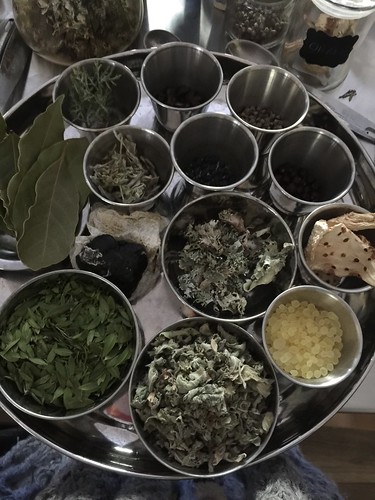
Local Kyphi Ingredients
In preparation for the Kyphi class I'm teaching February 21st, I've decided to experiment with making Kyphi with as many local ingredients as possible. I tried to use mostly plants and materials that I either grow or wild-harvest, or can be found locally theoretically speaking.
Some were included because they were traditionally part of the materials traded Incense Route and therefore have penetrated the local cuisine and pharmacopeia and are almost inseparable from the culture (such as Frankincense and Myrrh), and also I've included them because although the specimens I have are not grown locally - there is now a farm near the Dead Sea that grows them. The same is true for mastic (which although is from Greece, I can harvest my own - just wasn't patient enough to wait till next summer when I can collect enough resin!). And so on, for most of the resins. So this is not a strictly local product, but it carries the spirit of the landscape I now live in, and reflects its plant aromatic profile.

Local Kyphi in the Mortar
I began by soaking organic uncultured grapes in wine from the local vintner, and then set off to pound all the herbs I picked in the mortar and pestle. If you can recognize any of them in the pictures, and post a comment - you will be entered to win a little jar of my local Kyphi once it is made! It ended up very green and balsamic smelling, and with energy that is very vibrant and sweet, not unlike the Venus incense pastilles I made last year.
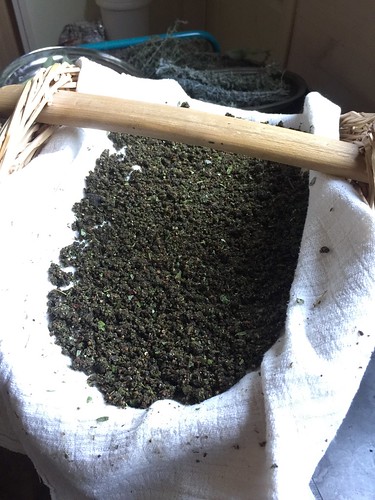
Local Kyphi in the Drying Basket
Here it is drying in a basket layered with a gauze fabric (okay, more like an antiquated baby diaper, remember those days? If you do then you're either very old or getting there!).

Labels: , , , , , , , ,

Thursday, January 24, 2019

Incense Course Begins!

Incense Workshop
Today I began teaching my first incense course - a series of incense classes, covering the main burning styles and incense making techniques. Using natural raw materials only, such as precious resins, gums, woods, spices and herbs, we will pulverize, grind and mix together raw materials that were used in incense making since time immemorial.  I am very excited for this workshop - because it is taught to a very special group of women, and also is giving me the push to improve my incense making skills and learn new techniques!

Here's what's planned for the course:

1. Smudge Wands
Introduction to incense history and raw materials. Forage botanicals for making incense wands/smudge stick from wild and local medicinal herbs.

2. Loose Incense
Spotlight on resins and composition of a loose incense using resins, herbs and spices.

3. Kyphi
Relying on an ancient Egyptian recipe, we'll pulverize and grind various resins, herbs, precious woods and spices in a mixture of wine and raisins, and create small pellets that can be burned on a charcoal or electric incense heater or diffuser. You'll be able to pick up the Kyphi you made after a week (or get it mailed to you).

4. Incense Pastilles
Incense "candy" that is made of various type of resins, with added liquid, rolled into balls and burnt on charcoal or on aromatherapy diffuser).
Very suitable for children, as this type of incense is faster to make and does not require long drying time, and can be taken home the same day.

5. Neirkoh
Japanese incense pastilles - like soft incense caramels that are designed for warming on a hot plate rather than burning. Made from complex aromatics and aged for several months.

6. Incense Trails & Body Incense
Unique Japanese technique for incense burning, as well as perfuming the body or cleansing before entering temples for prayer and meditation. This class also serves as preparation for the most complex form of combustible incense.

7. Incense Cones
More technically advanced, this incense is hand-shaped into little cones that can stand on their base and are self burning - just like the more familiar joss-sticks, once they are ignited, they burn slowly from the tip to the bottom. Preparing them requires fine balancing of the ingredients and meticulous shaping, therefore taking much longer. You'll be able to pick up the cones you made after a week (or get them mailed to you).

Labels: , , , , , , , , , , , , ,

Wednesday, February 17, 2016

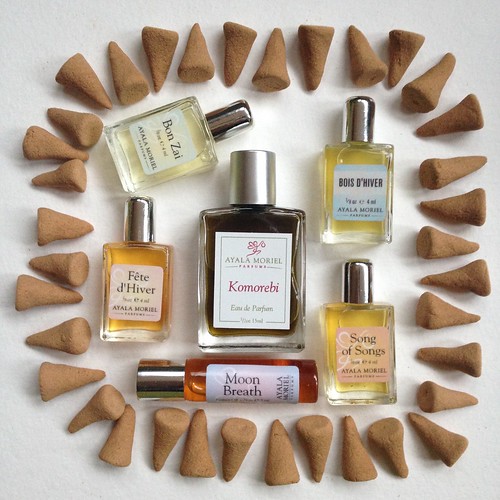
Jardin Parfum Reviews Ayala Moriel's Kyphi, Incense Cones and Komorebi Perfume

“That Ayala is a highly esteemed perfumer is no secret. She also has a talented hand at incense, another fragrant pursuit she has had perhaps as long as or longer, than perfume.”

Visit Dabney Rose's blog, Jardin Parfum, to read her thoughts on Komorebi and my incense cones and my vetiver take on ancient Egyptian Kyphi.

“Her vetiver  Kyphi was INCREDIBLE. At some point in her life she had to have been a ‘ladybug’ on the wall when the ancient Egyptian priests were formulating in their temples.”

Labels: , , , ,

Thursday, December 24, 2015

Incense Through the Ages

Smouldering Incense & Perfumes
It's winter. The most glorious season in Canada, where the energy is directed indoors, and focuses on social gatherings large and small. As usual, I'm an outsider peeking into what this is all about from the viewpoint of a traveller passing by. For, like, 17 years.

I am looking forward to the quite and solitude that tomorrow brings. For someone who grew up in Israel, it's funny to see how once a year, Canadians are experiencing the only tight-lid closure of stores and services. The rare sight observed today - of long, hectic lineups at the supermarkets and grocery stores, the traffic congestion, etc. are a weekly sight in Israel, where every Friday families stock up for a full day (gasp!) without shopping... I find it amusing.

One of my favourite things this time of year is walking in the West End (my neighbourhood  and home for my entire Canadian adventure) and coming across a waft of real, wood stove smoke. Am I the only human for whom the smell of pyrolysis stirs up strong emotions? I think not. It is at the same time a signal of danger in the forest, and the safety of the caveman's tribal bonfire.  No other recent can conjure so immediately and powerfully the feeling of freedom, adventure and coziness. It transports me to cozy nights with my family by the fireplace, my home village burning in a bush fire, and more recently - bonfires when camping in my imaginary gypsy tribe or spice caravan.

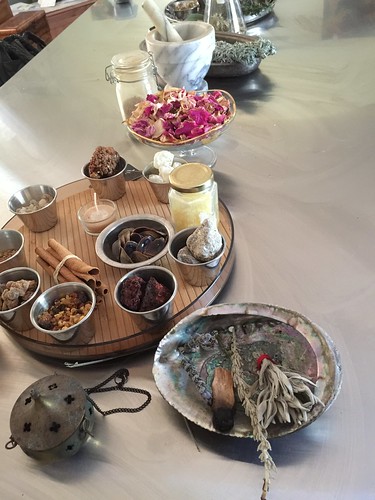
Come wintertime, and few things please me more than immerse myself in fragrant smoke. And I'm not alone - incense, and in particular - frankincense and myrrh, from the desert trees which grow wild and are cultivated in Southern Arabian peninsula and West Africa is a symbol of the Nativity Scene and is burnt in many Churches. Beginning with some basics, just straight-up burning of substances in their raw form, preferably on hot charcoals: white sage, leaves and twigs of redcedar, frankincense tears and sticks of palo santo (that tend to self-extiniguish repeatedly...). And then to some wonderful Egyptian Kyphi - a concoction that is my own modern spin on the ancient recipe. Although not accurate, it is done according to the technique and the scholarly deciphering of its original 16 ingredients. It may not be accurate, but I can attest to its fragrant heavenliness and ability to banish the worries of the day - which is what Kyphi is all about...

Dabney Rose's modern Kyphi

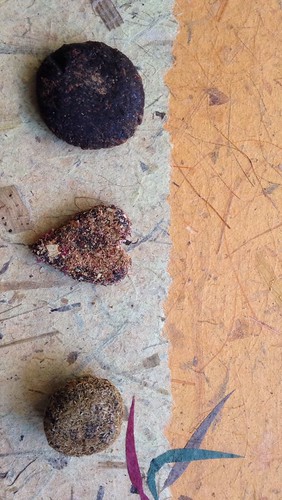
I've been blessed with wonderful incense friends, who generously send me their incense creations. Above you can see Dabney Rose's version of Kyphi, in 3 different "flavours" (from top to bottom): Soliliguy, Févriér Amour and Winter Sleep (Conifer). They are made very differently from mine, which is granular and is meant to be sprinkled on the hot coal. Rather, after the ingredients have been pounded into a more-or-less uniform level, they've been shaped into little "candies", and one is meant to break off little pieces to place on the hot charcoal, or on a mica plate. Although the shapes are adorable, I am wondering about the extra work required both by the incense maker (who needs to put a ton of effort into each piece!), and the user - who needs to break off the piece from a very hard piece of re-bound resins. Perhaps I am missing something in the process or the technique. It sure would make for an interesting ritual if there was a special knife that would cut through these elegantly.

But what truly matters, more than shape or form, is the scent itself. And in deep winter Winter Sleep is a most befitting incense to burn. It's a wonderful way to celebrate Winter Solstice; and once the celebrations are over -  to rejuvenate and counter the winter blues that tends to follow the over-partying or maybe just feeling left out after
The name is a bit misleading though: it's actually a great way to wake up from winter hibernation! The elegant incense candy smells like juniper, spruce needles and pinon pine, and it reminds me of a crisp winter walk in a snow-covered coniferous forest. When it's burning, I'm smelling primarily myrrh, but also the resinous coniferous notes and a sweet-balsamic after-note.

Another favourite of mine to burn at this time of year is Ross Urrere's "Ocean of Night" loose incense that look like kohl or charcoal with bits of woods and oakmoss strewn in. Ocean of Night is a rich, luxurious, ambery-balsamic yet floral blend that is very perfumey. It reminds me of the floral Russian and Greek Church incense, yet without the unpleasant synthetic aftertaste these have. It's like an incense version of Nuit de Noël!

Curious to explore more incense-themed perfumes - check out my Christmas 2015 Newsletter: Smouldering Incense Gift Guide.

Labels: , , , , , , , , ,

Friday, September 24, 2010

Fall Escapism: Champaca, Kyphi, Hiking and Chai

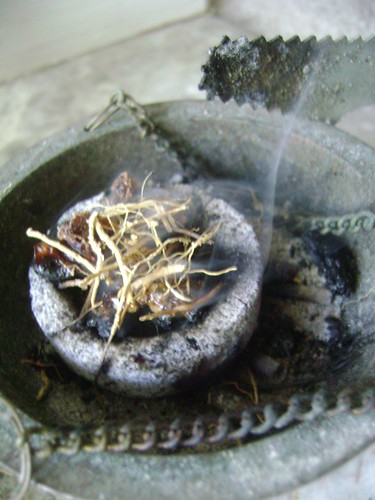
I'm burning Kyphi incense tonight, and it seems particularly befitting for the season. I've been "getting back to my roots" so to speak this week as I was teaching my intensive, week-long perfumery course focusing on the Oriental fragrance family. Kyphi is the most ancient perfume in the form of incense pellets - it combines about 16 different resins, spices and herbs, which are bound together with honey, raisins and wine. I made this incense three years ago (in September, actually...). It was burnt in ancient Egyptian temple in the evening, to "banish the worries of the day". And it does just that!

Now that my busiest season has began, I'm already finding it essential to keep my life balanced. Fall's transitions into the school year are exciting but also taxing. And with the market season beginning, I must take good care for not falling into stress-mode because this is going to last nearly 4 months and I am hardly going to have a single weekend off in the coming weeks!

I began making perfumes 9 years ago, when I was a full-time student in an intensive program, and also a very new single-mother. Stress was inevitable, and just as inevitable was me waking up at 5am every morning so that I can get a few moments to myself to burn incense and meditate. It seems like things are coming full circle now and I will be needing to go a similar route: wake up early and make sure my day does not begin with answering emails, or even making breakfast... But with thanking for and paying attention to my breathing. And what better way than burning incense to become aware of one's breath and deepen it?


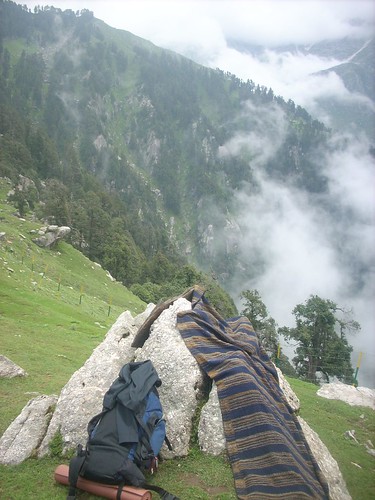
Hiking or simple long walks in the neighborhood (the West End is surrounded by water in 3 directions, as well as a nearly-natural rainforest of Stanley Park). Morning visits to Coal Harbour always make my day seem promising and exciting, and the water always pops new ideas into my head! And in the evening, a long stroll along the seawall all the way to Lost Lagoon, Beaver Lake or the Rose Garden are a good finale to a day - usually with a companion that can share the beauty of the scenery and reflect on the day that just gone by.

And than, of course, there is tea to warm my hands on that early morning stroll, or lift up my spirits just before the workday is over. Chai tea is special in that it has to be actually cooked in a pot with all the spices and milk - something I hardly ever do on a week day, but reserve for weekends and guests... Or when I decide to go to the Indian restaurant to get lunch instead of cook it myself... Fortunately, there is a really good one right next door and it feels like home there (sort of, except for the giant Bollywood marathon on their big-screen TV).


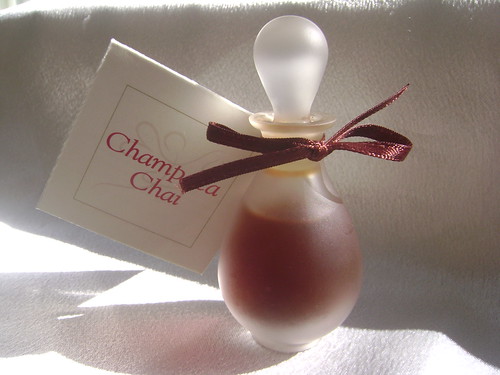
Champaca Chai, originally uploaded by Ayala Moriel.

And last but not least - here's a one-of-a-kind perfume that is especially appropriate for today: Champaca Chai. The fantasy of this perfume encompasses both the hiking, chai and smoky components that seem to save my mundane life from total disaster... It speaks to my fantasy of an outdoorsy tea ritual, preferably after a long hike on the mountains, and has a soothing milkiness to go with its rustic smoky surroundings. I also find the essence of champaca flower, with its complexity and fruitiness, to be reminiscent of Kyphi.

Top notes:
Ginger, Nutmeg, Mace, Cardamom, Fennel, Caraway

Heart notes:
Champaca, Jasmine, Coconut, Honey

Base notes:
Black Tea, Budhawood, Clove bud, Tonka bean

Labels: , , , , , , ,

Thursday, August 16, 2007

Back to the Basics: Burning Incense


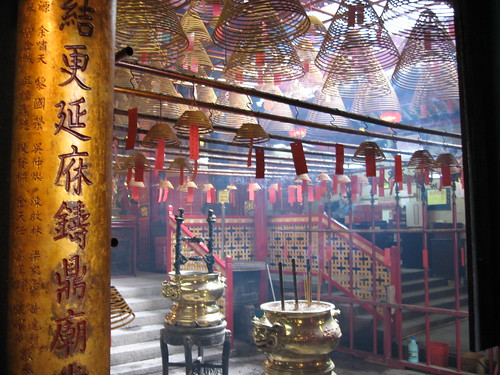
Beehives of Incense, originally uploaded by annavsculture.

In the very beginning of my work as a perfumer, I made incense. Not the cheap kind of incense made of pre-made incense sticks dipped in synthetic oils. But rather, loose incense, made of a combination of resins, wood barks, spices and herbs. Traditionally, these are burnt over hot charcoals in many religious spaces such as temples and churches. There is something really magical about entering a space like this. The scent of burning incense is what you notice first of all. And it’s been burnt there for many years (in some cases, hundred over hundreds of years). The incense permeates the walls of such temples and churches, sinks into the stone or wood, not to mention the clothes and hair of the people in it. Everybody becomes connected through smoke.

The best incense I’ve ever made was a kyphi formulation. It was not my recipe, but I was still very pleased with it all the same. The process for making kyphi is longer than any other incense, as it uses raisins and honey as an agent to glue together the differerent fragrant components (i.e.: frankincense, myrrh, juniper berries, cinnamon and so on). The raisins need to soak for quite a while and the whole process is sensual and magically fragrant. Forming the incense pellets also takes quite a while, as well as drying them out (to let any excess moisture out). The fragrant is never “burnt” and always pleasant with kyphi.

But I digress… What I really wanted to talk about is how incense really was the first form of perfume. It’s already a well known fact that the word “perfume” originates in Latin: Per Fumum means “through smoke”. What is less talked about is how it all started. And I feel that somehow, even though we don’t have the exact evidence for this – the way incense (and than perfume) was discovered is so deeply rooted in our conciousness that it can be a truly powerful tool to reconnect with our deepest selves and reestablish our connection with past generation and with the earth – thus perhaps securing a brighter future for the future generations.

I imagine incense was discovered one day when a few homo-sapiens or even less advanced species of humans made a fire and discovered that a certain plant (perhaps it was an ancient coniferous plant?) made the fire go higher, brighter and stronger. They may have also noticed a very strong and pleasant odour released at the same time. Bit by bit, our apish forefathers have discovered more and more plants, woods, resins and herbs that made the fire start quicker (the essential oils are highly flammable – just think about all the turpentine in pine trees for instance!). They also noticed that they feel better when they smell these burning plants, and their spiritual leaders or shamans used these as medicine to treat both body and soul, and as means to communicate with spiritual beings (represented by the visible, thick incense smoke emanating from these plants when burnt).
The earliest mention of incense is in the Epic of Gilgamesh, a Sumerian tale of The Flood. The Sumerian civilization existed nearly 7,000 years ago. The Egyptians have perfected the art of incense, medicine and also fat based perfumes (maceration of fragrant plant matter in oil, as well as solid perfumes). The Egyptian civilization started about 5,000 years ago. These are very early moments in human history, and even than, fragrance was connected to many aspects of human life: spirituality, beauty and health. Incense was a constant presence in the domain of spiritual work and worship sites. Incense was a way to heal the sick (get rid of evil spirits to banish the physical illness). And it was a luxury commodity among the rich.

Incense and fragrance had many spiritual and healing roles in the Indian and Chinese culture (Ayurveda and Chinese medicine both used aromatics and aromatic herbs for their healing properties).

It wasn’t until very recently that perfume have become “just” a commodity and a luxury item, as if disconnected from the other benefits it provides for us for our spiritual and physical well-being. It is funny that just as quickly as we in the West forgot about it, we were also fast to receive it again in the form of aromatherapy – an art of healing that has grown so fast as to lose most of its meaning in the last couple of years. The term is so overused, and synthetic aromatics are often substituting the real, natural ones in many commercial products that claim to be “aromatherapeutic”. And so aromatherapy grew fast, and than it just collapsed – instead of to oblivion, to a far worse real, the realm of being misused, misunderstood, over used and also used in not so careful ways.

We must respect the power that natural essences posses. They need to be used properly and sparsely in order to be used effectively (especially for medicinal or therapeutic use). There are many ways to benefit from natural essences in an “aromatherpeutic” way. When it comes to balancing emotions and connecting with ourselves (or our higher selves, if we are so ambitious!), incense is one such way. And setting time to enjoy and appreciate incense and get back to the basics. Breathing.

Labels: , ,