Thursday, June 29, 2017

Top of the Land

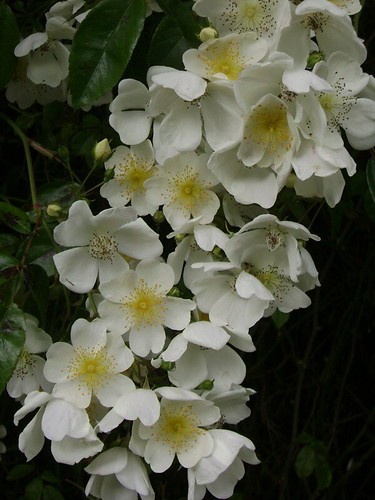
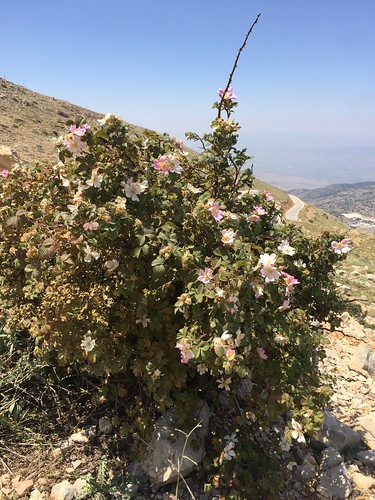
Wild Rose (Rosa canina) on the peak of Mt. Hermon
After picking a bunch of cherries to complete our breakfast we drove to the peak of Mount Hermon (Jabal A-Sheikh) - elevation 2,224m, which is accessible with chair lifts. It was a relatively hot day but still much more pleasant than the rest of the country - somewhere around 26c or so, with a very harsh sun yet a nice dry cool breeze ever so often.
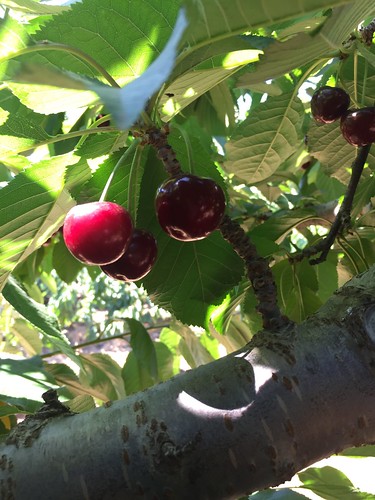
Cherry Picking
The vegetation is somewhat sparse but very special and with many varieties growing on this mountain. Some plants can be found in other northern places (for example: the now protected Wild artichoke (Gundelia tournefortii) - עכובית הגלגל, which grew in most parts of the country before), but others are endemic to this mountain alone, because of its exceptional conditions and placement. It is covered in snow all winter, and once it melts resembles a cool desert land, covered with white rocks and with no trees in sight. Dog roses (Rosa canina) are native to Israel, but are quite a rare sight otherwise. To find a bush in full bloom at the peak of Mt. Hermon was elating. Of course, it has a heavenly fragrance.

Peak of Mt. Hermon

Up on the peak, there is a sense that many of the plants here has some mysterious medicinal value, for some very specific and possibly rare conditions. I am imagining a time when climbing the mountain on foot would be a great ordeal (well, it still is - but most people use the road and then the gondola!). People would only go up the mountain for an important mission set forth by a divine guidance, a royal order, or a great and pressing need to save someone's life from a rare illness...
פריגה חלקת פרי
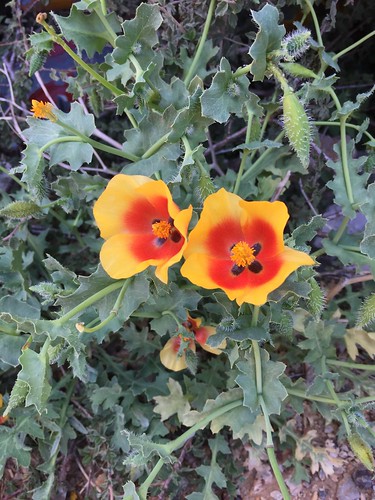
This poppy (Glaucium oxylobum פרגה קרחת/פריגה חלקת פרי), for example, is unique to Mt. Hermon and can't be found anywhere else in the country (but it can be found in high elevations - upwards of 1,100m - in the mountains of Turkey and Iran). I love its bright dual colours and contrasting "eyes". It blooms for a very long season - six months to be exact, from April when the snow melts, till the total dryness of September. There is a great variety between flowers, but they all share this startling, sudden contrasting colour change, and unusual display of three colours.
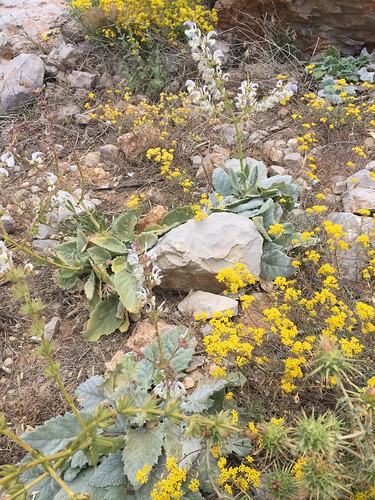
Salvia microstegia מרווה בוצינית + Alyssum baumgartnerianum אליסון חרמוני
Salvia microstegia (the hairy big leaves with white flowers), the thistle-looking plant is Cousinia hermonis (קוסיניה חרמונית), the yellow flowers are of Alyssum baumgartnerianum Bornm. (אליסון חרמוני), AKA madwort. It is not the only yellow flower found on Mt Hermon  - so don't confuse it with Lebanese St. John's Wort (Hypericum libanoticum) in Hebrew - פרע לבנוני, or with the two types of Achilea that grow there - Achillea biebersteinii (אכילאה קטנת-פרחים) and the endemic Achillea falcata (אכילאה גפורה).

There might also be a type of catnip (נפית קילקית?) Nepata - of some kind that I'm yet to completely ID), or a horehound in the pic. Which also reminds me of the unusual Lebanese horehound (Marrubium libanoticum Boiss) - in Hebrew מרוביון הלבנון/מרמר הלבנון, which is also a highly medicinal plant.
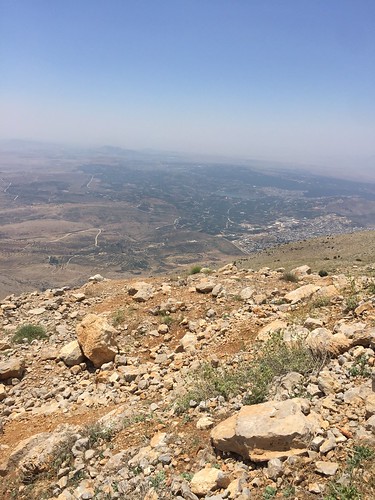
Israel|Syria border - view from peak of Mt. Hermon
Israel & Syria - view from above. Where the green ends Syria begins... It's sad but true, due to over-forestation and roaming in Syria, and on the other hand much planting of trees all across Israel.

Lastly, here is me and Miss T standing against this dramatic backdrop.
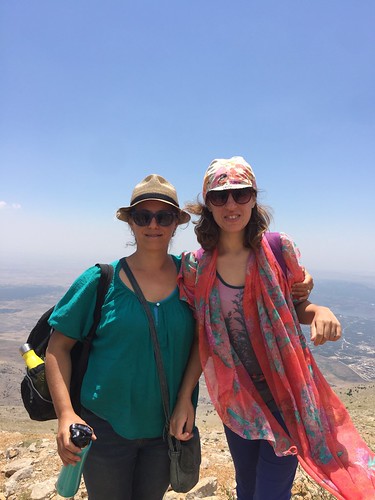
Israel|Syria Border - Peak of Mt. Hermon


Labels: , , , , , , , , , ,

Tuesday, June 02, 2015

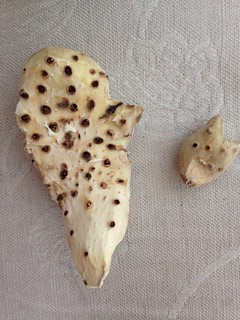
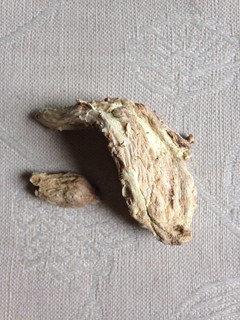
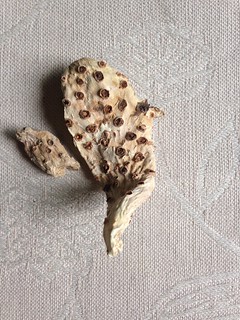
Orris: Flowers and Rhizomes

May Flowers
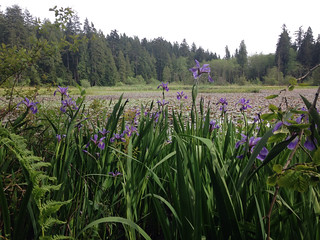
These purple iris flowers are an invasive species that are native to  as seen in Beaver Lake in Stanley Park, Vancouver. They are called Flag Iris (Iris psueudacorus) and also come in a yellow variety. Their rhizomes are not of any value to the fragrance industry but was used medicinally as an emetic, because of its high tannin level. It can be irritating to the skin and have an acrid taste. On the brighter side, it was used to clean water from heavy metals, as the roots has the ability of soaking these up and filter them out so to speak.

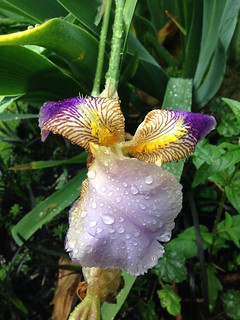
Iris germanica flower

These are the flowers of Iris germanica, which along with Iris pallida (AKA Florentine Iris, Sweet Iris or Dalmatian Iris) is a cultivar that is a descendant from the historic Iris mesopotamica which grows in the Middle East (it's a rare flower nowadays, but can be sighted in the Galilee in northern Israel). The flowers too have a wonderful aroma - which I'm surprised does not get featured in fragrances more often: it is buttery and soft, almost like white chocolate. But not yet powdery and dry like the orris butter produced from the root of the same plant.

The dried rhizomes of the wild plant was used historically for perfumes and cosmetic preparations from ancient times, what we now call Orris Root. The ground dried rhizomes were used in powders, and the chopped up roots in sachets and potpourri. Essential oil of the plant are one of the most costly perfume materials, and take 5 years to produce: the first 2 years, the plants are grown undisturbed, to allow them to develop the desired irone, which are responsible for their characteristic aroma. Then the entire field is uprooted, the rhizomes need to be washed and cleaned of all soil and sand, and peeled by hand. They are dried in a shaded area and are left to mature for additional 3 years, after which they will be ground to a powder and then will be steam distilled to produce what is known in the industry as "orris butter" - a buttery, powdery-waxy textured substance that has the scent of Parma violets, carrots and a baby's head and excellent fixative qualities that made it a staple in the European perfumer's organ. It is used in countless high-end fragrances, including all the Guerlain classics, at least in minute quantities in the signature Guerlinade accord, if not in higher doses as is evident in Apres l'Ondee, l'Heure Bleue and Shalimar. I've used it many of my fragrances for Ayala Moriel Parfums, sometimes in minute amount just to create that soft, diffusive, powdery quality, for example in Autumn, Cabaret and Espionage; or to accentuate the violet-like quality I was after, for example in Rainforest and Viola and Indigo. Other times, it can even be the star of the show (even if quite demure) as in Sahleb, which is practically an iris soliflore.

IMG_8562

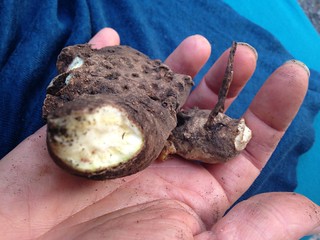
I've decided to experiment with this one piece of Iris germanica rhizome that I found in a neighbouring garden (they were hovering halfway above the ground, so I decided to pluck it away and see how the drying process goes).
First I washed them from all the dirt, using a mushroom brush to scrub it off the hidden places.
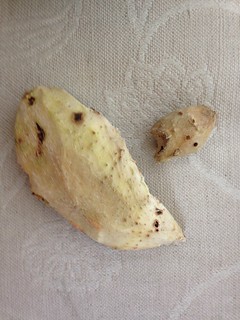
Then I used a potato peeler to scrape off the peel. And then I placed them in a dark wooden cabinet for drying and maturing...

IMG_8605

IMG_8606
A week later, the bottom concave part of of it, which was sitting inside bowl, began developing a bit of mold hairs unfortunatley, so I had to peel that further. I changed its position so that it is as exposed to air and not inside a bowl but directly on the wood. It seems okay now and has dried up quite nicely already (just 16 days in) and has even began to develop a bit of the characteristic orris butter smell. I'm pleasantly surprised so far; and mostly thrilled to have a whole root that I could demonstrate to my students with.
Orris Root

Orris Root

Labels: , , , , , , , ,

Sunday, May 22, 2011

White Spring at Lighthouse Park

I went for a hike today at Lighthouse Park, and stumbled upon some beautiful white flowers, not all of which were fragrant, but all the same beautiful:

The white lilacs were on the way to the park on Beacon Lane. Crisp looking and befitting a bridal bouquet in appearance alone... Their scent is just a tad cleaner and less sweet than the purple lilac.

Within the park, blooming tall shrubs of what looks like a wild pear judging by the flowers and leaves, but is more likely to be Saskatoon (which will turn into not too small-apple shaped berries later in the summer).

Red elderberry's flowers (aka elderflowers) are described in Plants of Coastal British Columbia as "White to creamy, small, with a strong, unpleasant odour; muberous, in a rounded or pyramidical parasol-like cluster". Admittedly, they did not smell all that bad to me... Not any worse than blackcurrants. But my nose is more tolerant than my taste buds, and I'm still not quite sure if I like elderflower cordial or not.

And last but not least, the pristine lily of the valley blooming by the rocks in the lighthouse keeper's garden. A feast to the senses and a pleasant surprise to find them in the forest by the sea!

Labels: , , , , , , ,

Tuesday, August 04, 2009

Persian Silk Tree


This unusual mimosa-like tree on the corner of Haro & Broughton street is in full bloom again. I haven't had a chance to blog about it last year, when its intoxicating and beautiful mimosa scent took me by surprise. I looked up and saw a tree covered with pompoms of pink and yellow acacia stamens. It's very fragrant, with a scent reminiscent of mimosa, honey, wood, pollen in the wind in the heat of Provence, and is very perfumey.

The name of the tree is Albizia julibrissin, and it's also called Persian Silk Tree. It's native to Asia (Iran, East China and Korea) and is from the Albizia family, which is a legume related to mimosa and acacia.

Labels:

Monday, July 02, 2007

Rosy Surprises


Rose Woody Clusters 30-06-2007, originally uploaded by Ayala Moriel.

As I was enjoying a weekendly stroll in Stanley Park this Saturday, I was surprised by series of roses with completely different smells lined up on the pathway that leads from downtown to 2nd Beach, and runs parallel to the Rhododendron Garden and Lost Lagoon’s trail.

The first rose I was so familiar with I didn’t even bother to take a photo. It was single-tiered, and with a luscious, fruity rose scent, very much like the one I’ve mentioned earlier this summer.


Roses Under Fir 30-06-2007, originally uploaded by Ayala Moriel.

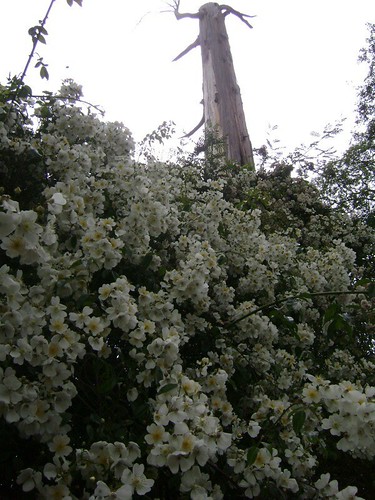
The next bush, however, was like nothing I’ve either seen nor smelled before. It was a tall, thick bush, laden with cluster of single tiered white roses, and so abundant that I almost lost track of time sniffing and photographing different clusters and individual roses. It was so peculiarly different from other roses: although the scent was intense and magnificent, it was also very light. It was what I can describe as both woody and airy. A similar feel comes from Atlas cedarwood and cabreuva oils, only with the added florally of rose. It was so light it almost reminded me of a water lily…


Rose Pink Indolic 30-06-2007, originally uploaded by Ayala Moriel.

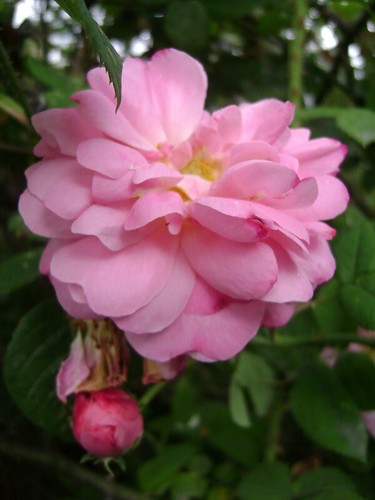
The second bush was less abundant and the roses were larger and pink. What struck me about this one was not so much its look as the scent of the flower: this pink rose was like no other pink rose. It was so shamelessly indolic that I could swear I smelled notes of jasmine and civet in there… Certainly not “innocent as a rose”…

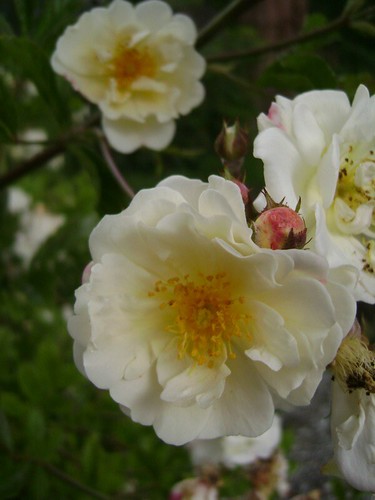
The next bush of white roses had tiered flowers whose scent was closer to what I would expect a white rose to smell like: the purity of a rose, perhaps with a certain peach-like qualities about it.

Rose Tiny 30-06-2007, originally uploaded by Ayala Moriel.

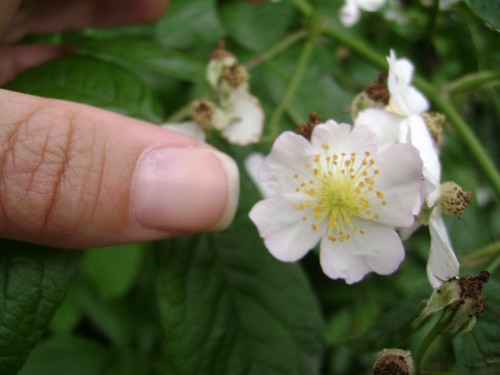
Last and of least significance was another white rose bush, single tiered again, with not particular odour that I could comment on, but it was every so tiny that it was about as wide as my thumbnail!

Labels: , ,

Wednesday, June 13, 2007

Peonies


Peony, originally uploaded by Ayala Moriel.

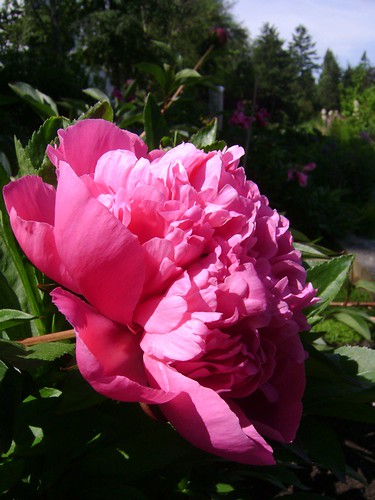
I’ve been wondering about the scent of peonies for a while. You see them mentioned so often as a note in mainstream perfumes. Yet, I couldn’t say I’ve smelled enough of them to recall the scent from memory. This summer, as if on demand, Vancouver’s gardens and nurseries seduce with me with peonies wherever I go. I even spotted them on reception desks by day and hair salons by night. I had encountered so many that I even managed to find a few adjective to describe them. To me, they smell like a combination of a subtly luscious rose, fresh carnation, and a hint of green. There is also a bit of a marigold element but it’s very subtle. There is nothing particularly original about peonies, they just smell like a lovely bouquet of these flowers. I guess it’s their voluptuous appearance, reminiscent of both of rose and an oversized carnation, sparks the imagination. It is hard not to notice it’s resemblance to many patterns in Chinese art, and perhaps this is what makes them seem so mysterious and vaguely oriental.

Thinking about it, it might just be possible to recreate it from naturals alone...


Phantom Peony, originally uploaded by Ayala Moriel.

Labels: , , , , , ,

THE Rose Bush


Luscious Rose, originally uploaded by Ayala Moriel.

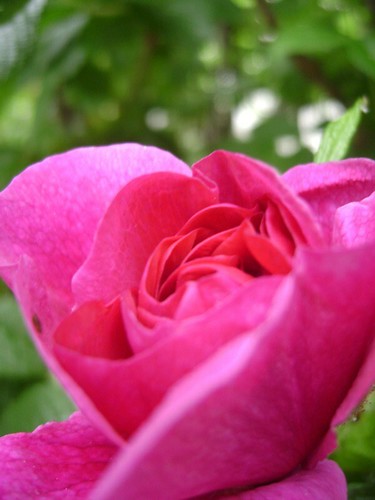
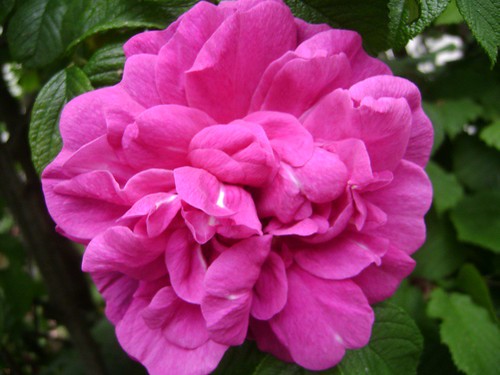
I have passed by this rose bush a million times, but perhaps it is only now, after 9 summers in the city, that I am starting to associate it with itself and with here and now – as opposed to the roses of my childhood (a rare and precious encounter, but nevertheless, it belonged only there for the longest time and seemed to have hard time moving on). These roses are just… perfect. Rosier than any other rose, with honeyed, full-bodied, wine-like presence. I’ve stopped by this rose bush so many times, ignoring the embarrassingly pitiful glances from by passers. Ignoring the laughter of those observing how difficult it is for me to move on, as my nose pulls me back into the deep velvety petals, my arms heavy with grocery bags and begging me to just move on and go straight home, but I can’t… In case you didn’t get it the first time – these roses smell perfect. Sigh…


Voluptious Rose, originally uploaded by Ayala Moriel.

Labels: , , , , ,

Tree of Mystery


Tree of Mystery, originally uploaded by Ayala Moriel.
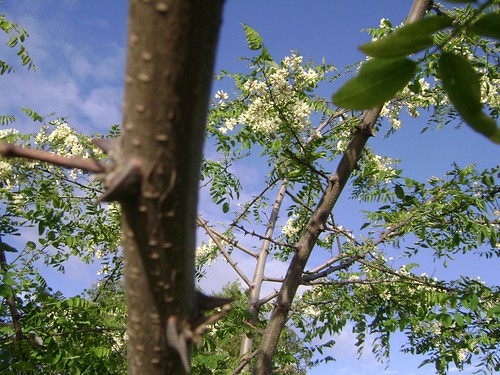
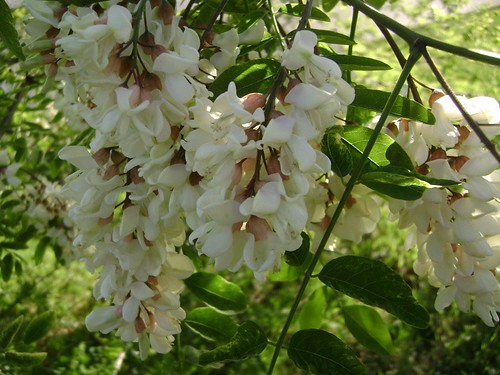
The first time I encountered this tree was in east Vancouver, near Grandview elementary school. I was amazed at how closely it resembled orange blossom, though it has nothing to do with orange. It looks as if it belongs to the fabacea (or legumes) family, just like Spanish Broom, mimosa and Sweet Pea.
And indeed, it shares quite a bit of similarity to sweet pea as well – which I haven’t noticed before. Overall, it smells like a mélange of orange blossom, sweet pea, and a very indolic jasmine, to the point that you’d think there is some civet thrown in… only that this isn’t perfume! It’s a flower and there couldn’t possibly be any civet in there even if you tried hard to find it. Maybe in coffee, but not here…


Mysterious White Blossoms 01, originally uploaded by Ayala Moriel.
P.s. Thanks to my reader, Veronica, I now know the identity of the mystery tree: Robinia pseuodoacacia, aka Black Locust or Witte Acacia. Veronica, please email me so I can thank you properly with a mini of my mimosa perfume, Les Nuages de Joie Jaune.

According to W.A. Poucher's Perfumes, Cosmetics and Soaps (Vol. 1, p. 296): "Source: Natural. Flowers of Robinio pseudo-acacia, L. Leguminosae. The absolute is obtained by extraction with volatile solvents. Possesses an intense odour of the blossoms. Chemical: Contains indole, methyl antrhanilate, linalool, benzyl alcohol, heliotropin, and trepineol, with traces of aldehydes and ketones of peach odour". 

Labels: , , , ,

Lilac


Lilac, originally uploaded by Ayala Moriel.

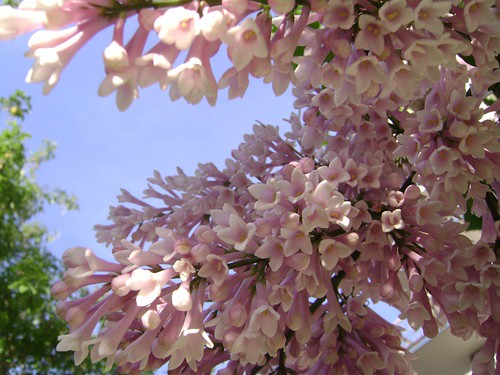
There are so many different lilacs here. Different colours, different sizes of clusters. Maybe this particular one isn’t exactly lilac either. But it sure smells like one. And against the pale blue sky, it is starting to become a symbol of summer for me. In a cheerful way, and without all the misty, dewy and a bit melancholy aspects that lilac can sometimes have on me.

Labels: , , , ,

Sunday, April 01, 2007

Acacia, Botanical Invasion and Leather


Mimosa, originally uploaded by Ayala Moriel.

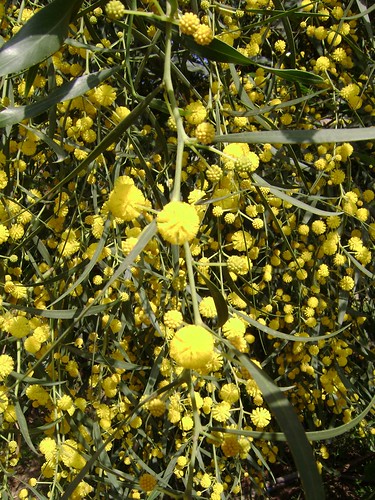
In the past two weeks, I’ve been traveling back and forth between Tel Aviv and my little village up north. In one of our rides together, my brother Yotam pointed out to me the dangerous abundance of Mimosas across the country, and the fact that they are now considered invasive species in Israel. Mimosas were sparse and almost exotic way back when, and I remember specific spots along the road where they could be found. When the blooming season arrived, we would pick them for my step-grandmother, who admired them greatly. Now, however, they can be found everywhere, not just in parks and city gardens or along the roads. They can be found in the middle of fields or on hillsides, where they are gradually taking over and use up resources such as space and water, therefore endangering the survival of the indigenous plants.

Now, in springtime, the view of mimosa is glorious and abundant, particularly in full bloom. Otherwise, these bushes embody the mood of desert and negligent greenery scattered in random places where it leaves no impression whatsoever except, perhaps, the gloom of heat and burning sunrays.

Mimosa is from the family of Fabaceae, which also includes the legumes. And indeed it has seeds that are arranged in elongated pods. It belongs to the subfamily of Mimosoideae, which includes also plants, shrubs and trees, some of which perform rapid movement like the “touch me not” plant (Mimosa Pudica).

The Acacia (commonly known as Mimosa) is an invasive species in other parts of the world. Although it is native to Australia, it is cultivated in countries such as Egypt, Morocco, France, Italy, Algiria, Lebanon an India. I suspect it was brought Israel at the turn of the century, along with Eucalpytus trees which exude an equally gloomy appearance where they remain as a statue to lost wetlands or malaria-beaten swamps and marshes that my Zionist ancestors fought vigorously and turned into depressing little forests instead.

The particular mimosa that is widespread in Israel is the Blue Leaf Wattle (Acacia cyanophylla). It is not extremely fragrant like the Acacia decurrens or the Acacia farnesiana (Cassie). But it does have a light, floral powdery sweet aroma wafting about it without making too much effort to leave an impression. I noticed that the scent is more apparent when smelled from distance, rather than sticking your nostrils amongst the pollen-laden wands decorated with the little yellow pompoms.

Mimosa has many uses in the leather industry. The bark as well as the pods are rich in tannins, and therefore make an excellent agent for preserving and tanning the leather. By way of fortune, I had the honour to get some information about the uses of mimosa from Stu Miller, a life long leather tanner and an expert in the field who consulted to leather tanneries across the world. mimosa bark. Mr. Miller’s daughter is known to some of you as Loukumi in Basenotes or Elizabeada in Perfume of Life forum. When she tried my mimosa soliflore, Les Nuages de Joie Jaune, she immediately recognized a familiar scent from her father’s tannery. She was intrigued and assisted me in finding out a little more about the use of mimosa in modern tanning industry, which, surprisingly, still uses many natural and locally grown materials in the tanning process. For instance: Cabracho from Argentina, chestnut extract, and sumac which used to come from Albania but is pretty rare today (sumac, in Hebrew, is called “Og Haburskaim”, which means “Plant of the Leather Tanners”, and grows wild in the mountains of Jerusalem), mangrove. Many tanneries use plants that are rich in tannin that are grown locally, for instance - some kinds of Eucalyptus in Australia, and unknown plants in South America, that are “used to tan fluffy curly white sheep skins that we sometimes see here”.

Mr. Miller’s tannery imported powdered mimosa pods from plantations in Africa and Brazil, which had 40-50% tannin. It was particularly used for tanning saddle leather, which tanned and dyed entirely with vegetable substances. At times, iron is added to mimosa powder to create a black dye: the tannin reacts to the iron and turns black. When asked if the mimosa pods had any smell, Mr. Miller said they just smelled like wood. He suggested that the scent his daughter smelled was a solvent – either butyl acetate (which smells a bit like bananas and is commonly used in the flavouring industry, particularly to create the scent of Granny Smith apples), or butyl alcohol.

The two species of mimosa that are of particular interest from perfumery as well as aromatherapy aspects are commonly called Cassie and Mimosa. Mimosa is the Acacia decurrens (Green Wattle) species. It is a middle to top note, with a scent that is at once watery, powdery, only slightly flowery and woody and very much cucumber-like. The absolute is a thick substance that tends to solidify once exposed to air and become brittle. This absolute is high in Palmic aldehyde, anisic acid, enanthic acid, acetic acid, phenols.
Because of its antiseptic and astringent properties, mimosa in aromatherapy, it is used as a muscle relaxant, skin conditioner, and for skincare of oily and sensitive skin. It also assists in nervous tension, anxiety, stress and insomnia.
Mimosa is mostly grown in Australia, Africa, France, Italy (based on HerbBee).

Acacia Farnesiana, AKA Sweet Acacia or Cassie absolute, is an unusual floral note: it is one of the most rare floral base notes. It has a far more intense, wet quality to it than the mimosa absolute has. It smells green, woody, wet, similar somewhat to violet leaf, yet floral with an intensity that is quite similar to that of jasmine. It is a valuable fixative in floral compositions.
According to the HerbBee, Cassie absolute contains Benzyl alcohol, methyl salicylate, farnesol, geraniol, linalool.
It is considered anti-rheumatic, antiseptic, anti-spasmodic, aphrodisiac, balsamic, and can be also be an insecticide.
In aromatherapy, it is used for rheumatism, dry skin, sensitive skin, increases sexual desire, depression, nervous exhaustion, stress. It is also used in the flavour industry. Cassie is mostly grown in France, Egypt, Lebanon, Morocco, Algeria and India.

Coming up next: reviews of mimosa perfumes.


Labels: , , , ,

Saturday, July 01, 2006

Dam Hamacabbim = Helichrysum Sanguineum = Red Everlasting

One thing I should have done when I packed my luggage 8 years ago to moved to Vancouver was to my botanist’s bible, the guide (or definer) of Mediterranen plants. Yes, that strange thick book that helps you to find the Latin name and common name for every plant you see. I never thought I would even need to use one here, because there are no Mediterranen plants growing here. Innocently, I thought to myself that the West Coast Plant Guide will be sufficient to keep me connected to the Plant Kingdom, so I can call each flower its name when the time comes to communicate with them...

Alas, I was so wrong. I should have known better, and take the Mediterranean book with me. But how could I have possibly know that I would ever need to use it, even if just for the sake of finding out which aromatic plants grew in my country, or just to remember a name of a flower for an obscure article I will have on something called “blog” 8 years from than? The answer is, I wouldn’t have possibly be able to know. And so, I am very thankful that at least I kept the book in the safe hands of people that would use it and would be able to answer my question when I am just about to publish a ground breaking article in my blog, about a tiny flower that looks like droplets of blood. Sometimes Google just don't cut it. At least not when it comes to matching the folklor names of certain Jewish flowers with their Latin names.

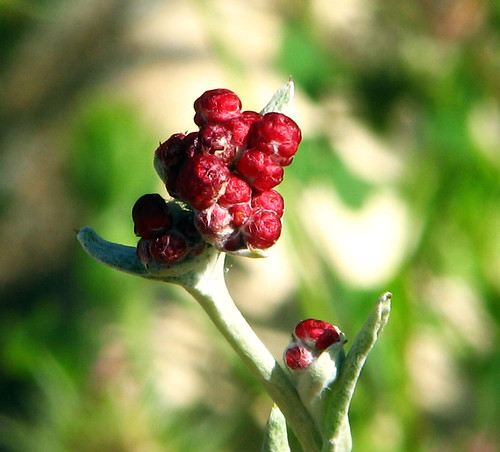
So thanks to my mother and my grandmother (who shared between them the task of looking up the flower, and than emailing me the information), I now know that the little modest though strikingly beautiful flower, that is commonly known as “Dam Hamacabbim” (which literally means “Maccabees’ Blood”, allegedly grown out of the drops of blood that the Maccabees lost in their battles with the Helenist invaders sometime around 165 BC, rescued the temple and found the little can of oil, and to whom all Jews should be thankful if they like latkes and sufganiot/donuts). It is apparently a type of immortelle – from the same family of the immortelle we use in perfumery. Only that this red everlasting flower has non scent that I can recall, and even if it had any, it would be impossible to obtain it from the very scarce plants that appropriately bloom every year around Chanukka.

On another note, there is another type of everlasting flower in Israel, though I think it’s from a different family altogether – it’s purple, and looks like it’s made of paper, and grows on the beach. It is very often used in floral bouquets – everywhere in the world, I suspect – as it takes ages for the flowers to fade. They look dry even when they are fresh. If you know the name of this flower, let me know.

Labels: , ,

Sunday, May 21, 2006

Saturday at the Rhododendron Garden

A couple of weeks ago, I was welcomed every morning by the refreshing and intoxicating lily-like scents of the yellow rhododendrons in my back garden and every evening reminded me that it’s time to go visit the rhododendron garden in Stanley Park. If you happen to be visiting in Vancouver at this time of the year, don’t miss a stroll along the paths of this extraordinarily beautiful and romantic garden. And if you live in Vancouver you can enjoy it year around – it is a lovely stroll even when the rhododendrons are not in full bloom as they are now…

Although there are a number of rhododendrons native to Europe and North America, for the most part – we owe the beauty and variety of rhododendrons to Asia – where there is are numerous species growing wild on the Himalaya, in Tibet, China, Japan and in the Sikkim region in India (to name just a few instances). If you like, you can read more on the history of rhododendrons.

In Greek rhododendron means “Rose Tree”. And like roses, there is an incredible amount of hybrids. The diversity of fragrance found amongst rhododendron flowers is very much like that of lilies. Therefore, I will not hide my puzzlement at why does rhododendron not have a more respected place in perfumery. Besides a few perfumes in my own line (Fetish and Rebellius which both use wild rhododendron from Nepal), I have only seen it listed as a note in Estee Lauder’s Intuition. For some reason, despite the abundance of flowers and the fact that the leaves and stems themselves possess a sweet, green-balsamic and slightly floral aroma – it is hard to procure rhododendron oil or absolute. Perhaps the toxicity of some of the varieties (the leaves, nectar and pollen of some of the species are toxic, and it is said that the honey from rhododendron or azalea flowers can make people ill). Maybe I need to join one of those secret rhododendron cults to find the answer…

The following photos were all taken last Saturday, May 13th 2006. I decided to include both varieties that had a significant odour and those that were a mare visual delight… Rhododendrons present quite a variety of colours, sizes, scents and also the shapes of the flowers vary tremendously. I noticed that the ones that had a lily shape were the most fragrant, and for the most part smelled like lilies.

Labels: , , ,

Beyond Paradise

My favourites were the one I have titled “Beyond Paradise” as it smells, in my opinion, the way Estee Lauder’s perfume of that name would dream of smelling. I think you can guess which one I like better. The colours are so tropical in this one, and so is the scent – a shameless tropical floral that asks to be worn on the head or make into a lay. It’s heady, fresh, fruity… Sounds like a familiar ad copy of the florals from recent years? They only wish they would live up to this rhododendron’s standards!

Labels: , , ,

Rhododendron Eyelashes

These are the yellow rhododendrons that were making eyes to me in my garden every day (they still are, but the mascara is starting to fall off…). They have an intense yet fresh lily scent, just like a wild yellow Alpine lily.

Labels: , , ,

Sun Tan Lotion


I hope that the breeder of this hybrid was wise enough to patent the scent of this rhododendron, as it is now used to scent quite a few sun screen lotions… It’s smells gorgeous as a flower and a bit of a nuisance as a sun tan lotion.

Labels: , , ,

Tiger Lily

This rhododendron not only has the colours of tiger lily, it also smells like one! A very heady, sweet, indolic floral.

Labels: , , ,

More Lily Shaped Rhododendrons

These look like lilies, and smell like lilies...

Labels: , , ,

Orchid

The variety of rhododendron is quite incredible. This rhododendron flower was not very fragrant, but it looks like an orchid.

Labels: , , ,

Coral Bells

Labels: , , ,

Two White Rhododendrons

A rhododendron tree:


Here is a classic white rhododendron:

Labels: , , ,