Thursday, January 05, 2017

Smoky Narcissus

Narkiss

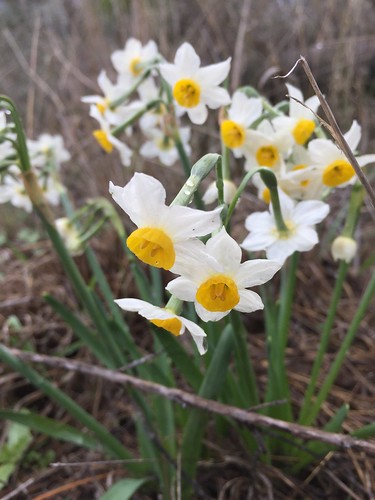
Wild narcissus (N. tazetta) and paperweights (N. 'Chinese Sacred Lily') are growing in my soon-to-be garden and in the mountainous wilderness that is its backyard. The wild one smells a thousand times better, in my humble opinion.... Especially, I've been haunted by its fragrance at night time, mingled with smoke from all the wood stoves used for heating in the village... Smells like a very fancy, smoky-floral beeswax candle burning. Not that this description does it any justice. I wish I could capture it in a perfume. Narkiss has some of the qualities (herbaceous, waxy-animalic) but as always, nature beats us all perfumers to a pulp. Other perfumes along these lines that I recall are Tom Ford's Velvet Gardenia and Shanghai Lily (I must remember to scout a sample size of that soon). Caron's famous Narcisse Noir also belongs to this territory, albeit it's much more aldehyde-heavy and it also has gasoline-like top-notes. Another scent it reminds me is of some of the Feu de Bois candle by Dyptique.

Those surprising moments when you discover a new yet familiar scent in the natural surroundings, truly are the best.

Labels: , , , , ,

Thursday, December 24, 2015

Incense Through the Ages

Smouldering Incense & Perfumes
It's winter. The most glorious season in Canada, where the energy is directed indoors, and focuses on social gatherings large and small. As usual, I'm an outsider peeking into what this is all about from the viewpoint of a traveller passing by. For, like, 17 years.

I am looking forward to the quite and solitude that tomorrow brings. For someone who grew up in Israel, it's funny to see how once a year, Canadians are experiencing the only tight-lid closure of stores and services. The rare sight observed today - of long, hectic lineups at the supermarkets and grocery stores, the traffic congestion, etc. are a weekly sight in Israel, where every Friday families stock up for a full day (gasp!) without shopping... I find it amusing.

One of my favourite things this time of year is walking in the West End (my neighbourhood  and home for my entire Canadian adventure) and coming across a waft of real, wood stove smoke. Am I the only human for whom the smell of pyrolysis stirs up strong emotions? I think not. It is at the same time a signal of danger in the forest, and the safety of the caveman's tribal bonfire.  No other recent can conjure so immediately and powerfully the feeling of freedom, adventure and coziness. It transports me to cozy nights with my family by the fireplace, my home village burning in a bush fire, and more recently - bonfires when camping in my imaginary gypsy tribe or spice caravan.

Come wintertime, and few things please me more than immerse myself in fragrant smoke. And I'm not alone - incense, and in particular - frankincense and myrrh, from the desert trees which grow wild and are cultivated in Southern Arabian peninsula and West Africa is a symbol of the Nativity Scene and is burnt in many Churches. Beginning with some basics, just straight-up burning of substances in their raw form, preferably on hot charcoals: white sage, leaves and twigs of redcedar, frankincense tears and sticks of palo santo (that tend to self-extiniguish repeatedly...). And then to some wonderful Egyptian Kyphi - a concoction that is my own modern spin on the ancient recipe. Although not accurate, it is done according to the technique and the scholarly deciphering of its original 16 ingredients. It may not be accurate, but I can attest to its fragrant heavenliness and ability to banish the worries of the day - which is what Kyphi is all about...
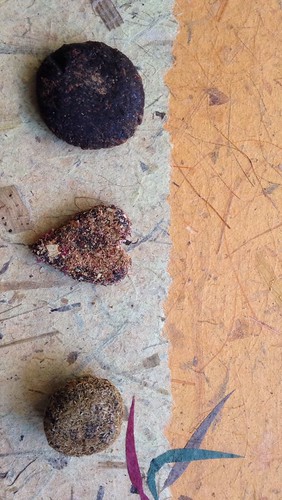
Dabney Rose's modern Kyphi

I've been blessed with wonderful incense friends, who generously send me their incense creations. Above you can see Dabney Rose's version of Kyphi, in 3 different "flavours" (from top to bottom): Soliliguy, Févriér Amour and Winter Sleep (Conifer). They are made very differently from mine, which is granular and is meant to be sprinkled on the hot coal. Rather, after the ingredients have been pounded into a more-or-less uniform level, they've been shaped into little "candies", and one is meant to break off little pieces to place on the hot charcoal, or on a mica plate. Although the shapes are adorable, I am wondering about the extra work required both by the incense maker (who needs to put a ton of effort into each piece!), and the user - who needs to break off the piece from a very hard piece of re-bound resins. Perhaps I am missing something in the process or the technique. It sure would make for an interesting ritual if there was a special knife that would cut through these elegantly.

But what truly matters, more than shape or form, is the scent itself. And in deep winter Winter Sleep is a most befitting incense to burn. It's a wonderful way to celebrate Winter Solstice; and once the celebrations are over -  to rejuvenate and counter the winter blues that tends to follow the over-partying or maybe just feeling left out after
The name is a bit misleading though: it's actually a great way to wake up from winter hibernation! The elegant incense candy smells like juniper, spruce needles and pinon pine, and it reminds me of a crisp winter walk in a snow-covered coniferous forest. When it's burning, I'm smelling primarily myrrh, but also the resinous coniferous notes and a sweet-balsamic after-note.

Another favourite of mine to burn at this time of year is Ross Urrere's "Ocean of Night" loose incense that look like kohl or charcoal with bits of woods and oakmoss strewn in. Ocean of Night is a rich, luxurious, ambery-balsamic yet floral blend that is very perfumey. It reminds me of the floral Russian and Greek Church incense, yet without the unpleasant synthetic aftertaste these have. It's like an incense version of Nuit de Noël!

Curious to explore more incense-themed perfumes - check out my Christmas 2015 Newsletter: Smouldering Incense Gift Guide.

Labels: , , , , , , , , ,

Monday, July 06, 2015

Wildfires

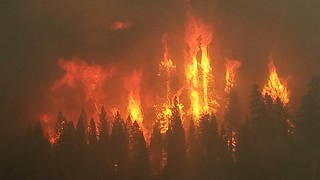
King Fire - Stumpy Meadows

Wildfires all over the region have cast a dark smokescreen over what seemed to be endlessly blue skies. Now there's smoke everywhere. You can look the sun straight in the eye through it without squinting or blinking. It's just an ominous circle of orange-red.

The mountains to the north are invisible, one can't see anymore than just a few buildings away - not unlike a heavily foggy San Francisco-esque day. Except that now there is also a multitude of sensations added to the experience: yesterday as I drove back to the city after spending the day at Golden Ears provincial park, the smell of burning rainforest welcomed my nostrils like sacrificial incense of the most eerily delicious scent. The kind of joss-sticks that only God should be allowed to be lighting afire: entire old-growth Douglas fir and red cedar, burnt in their entirety, from the fragrantly sweet needles to the moss-covered twigs, branches, bark, heartwoods and all the way to the roots. 

My eyes welled up with tears whenever I rolled down the window or stepped out again to realize this is not a bad dream. The mountain forests are burning. In some of my absolute favourite places here too, places I dreamed I would call home someday: Sechelt, Pemberton... By the time the ominous red sun has completely set, the smoke was so thick that my eyes were stung by this communal campfire of massive proportion. We were all walking the streets looking confused, unsettled, worried. Non of the cheery mood that accompanies intentional burning of cedar logs, and no marshmallows were roasted and no potatoes recovered from the embers and they were. Embarrassingly, I also have to admit I enjoyed that smell... If you want to get an idea of what that is like - dip scent strips in the following oils: red cedar, fir absolute and cade or birch tar.

The purpose of this post is not to whine about the smoke in the city (whose inhabitants like to complain about anything that slightly inconveniences us as far as weather goes). I know it is far worse than here where the fires are ablaze right now, and for days remain "contained at zero percent".  There simply have to be more measures to be taken seriously to both prevent and combat fires at such humongous scale. And I would be the first one to go up to those mountains and re-plant them with new forests. 

I know how terrible it is, because my home village is amidst wild bush, and that gets easily set on fire - either by human error, carelessness or simple nasty intentions. There is an illegal pile of garbage to the east of the village, and as much as a glass that catches the sunlight or an idiot trowing a cigarette butt from a passing car on a day where the wind from the East is blowing - can start a bush fire, if not burn down entire houses to the ground. Which it did, back in June 1988.  Five homes were lost, and it took a huge toll on these families and the entire community to rebuild it. Seeing old trees we used to play under disappear forever, and the fire line stop only 2m away from my family's home was a tough sight to digest and we too many years to process it and heal. Only now, 27 years later, some of the carob and oak trees begin to look sorta similar to their former ancestors that graced the hills behind us, and the thorny bush populations is beginning to tone down a bit... We continually re-plant the hills  and wild areas in the village with more local wild trees, to help bring it back to what it used to be - or maybe even better. But that taste in my mouth of burnt bush dampened by water is one I would never forget. Nor will I forget the same heavy odour soaked into every nook and cranny in our home, every garment smelling like it for weeks on end, and the scorched hills and meadows a charcoal-black for years and years to come until, finally, new perennial vegetation revived. 

I woke up this morning and the ancient-forest incense smell disappeared, and was replaced by the scent of fires that have had water poured all over them. I hope this means a good sign that the fire fighters are beginning to contain them and that this disaster will come to and end soon. But we can't be too optimistic: 
The extreme drought conditions, unusual for our rainforest province, have reached a worrisome levels. There hasn't been a proper rain (typically we get at least one good dose of rain a week, even in the hottest months).  And now the worst predictions have been confirmed. There have been over 800 fires in British Columbia this year. So I ask you all to pray for rain to return to our rainforest, and for those of you who live here - please, oh please be more frugal with your water use! We can handle dry lawns and shorter showers; but this planet can't afford to lose its largest temperate forest, with one of the most diverse and productive biomass! 

Labels: , , , , , , ,

Thursday, August 22, 2013

My Vanilla

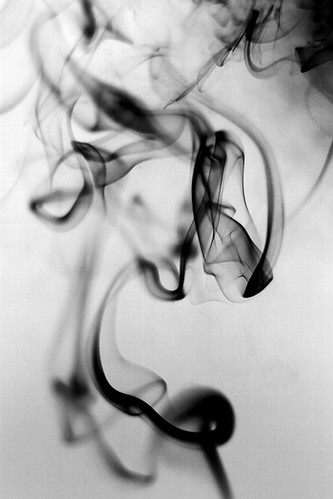
Smoke Gets In Your Eyes by Gemma Maree
Smoke Gets In Your Eyes, a photo by Gemma Maree on Flickr.
Anna Zworykina Perfumes' My Vanilla is a juicy bundle of cured vanilla beans whose sweetness is cut by green lentsicus leaves and smouldering incense. Through the thick smoke you can feel an exotic sweetness that is surprisingly floral - not at all gourmand as one would expect from anything containing "vanilla" in its title. It is spicy, exotic, narcotic. While I can see how vanilla migh`t have been a starting point for this fragrance - the result is not vanilla-dominated. Rather, it is a voluptuous oriental, influenced by the bombastic nature of Shalimar: burnt sugar and sweet spices are balanced with intensely smoky and slightly animalic choya nakh (destructive distillation of seashells) smoky-woody cedar to counterpoint the sweetness and pastry association, and perfumed with indolic jasmine and buttery orris and tonka beans. A very interesting addition to my gradually growing list of favourite all-natural perfumes. At first, My Vanilla has a strong, almost heavy presence - yet is utterly enjoyable to wear. The kind of scent that requires a special occasion. But of course like a good oriental, it fades into the softest, sweet whisper of vanilla.

Top notes: Virginia Cedarwood, Black Pepper, Cardamom, Mastic
Heart notes: Jasmine, Champaca, Orange Blossom, Orris Root, Cloves, Nutmeg
Base notes: Vanilla Absolute, Vanilla CO2, Vanilla Extract, Choya Loban, Tonka Bean, Opoponax

Labels: , , , , ,

Monday, October 15, 2012

Monkey Monday: Smoke without Fire

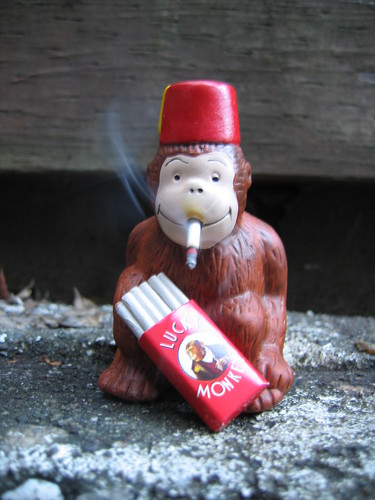
oh, smoking monkey! by Bread Mouth
oh, smoking monkey!, a photo by Bread Mouth on Flickr.
Is there really is no smoke without fire?
Last week, I discovered yet another hidden use of fragrance when the fire department came for their regular smoke-alarm tests in my building to activate the dreadful digital monsters with a blast of musk-infested spray. It was perhaps subtle, but nevertheless smelled very similar to a cross between Kiehl’s Original Musk and The Body Shop’s ever so popular White Musk. Thanksfully they were gone in a giffy, just a few moments after the screaming monster was appeased and shut-off (I am convinced they were designed for deaf people who don’t ever cook – because every time I get any action in the kitchen they have to protest!).

While I agree that one should always look carefully into what are the ingredients in the products they use; I must admit that fine fragrances are misguidedly overly targeted and are the subject of far more attacks than they deserve. Even if you use a perfume that contains synthetics, the amount you use (unless you're over using it) is just a little dab on both wrists and maybe the neck too (or spritzes, if you use a spray application). You have control over how much of fragrance you expose yourself to with the fine fragrances (and these are parfums, eaux de toilette, eaux de parfums and eaux de cologne).

In my humble opinion, it is the functional fragrances that are to blame for our over-exposure to toxic aroma-chemicals. Most people don't know it, but almost any product you buy is scented - and this applies not only to body products or fine fragrances, but also to the following unlikely list:
Natural gas (it’s otherwise odorless, and is artificially scented so we can detect leaks)
Plastic products (any and all; including kids' and babies' toys)
Rubber (ditto)
Paint
Tires
Leather goods
House cleaning products
Paper
…and so on...

I wish perfumes were less attacked, because it is also an art form, and because of ridiculous regulations that were designed to make the fragrance companies stronger and richer (that is far more higher on the agenda list than the public safety, I'm sorry to say) - this art form is in danger of extinction now. These we have a lot less control over how much they affect us, because they are everywhere in products we are using.

And that is it for my opinionated Monkey Monday. I don’t anticipate a huge debate as most of the visitors to this blog are perfume lovers; but nevertheless – if you voice your opinion, or add more weird objects and unlikely scented products that surprisingly artificially scented - you will earn the right to be entered into my weekly giveaway. This time around it’s a sample package of solid perfumes by Sweet Anthem – which also has a shop in Seattle where you can buy perfumes made in the West Coast, including Ayala Moriel Parfums.

Labels: , , , , , , ,

Tuesday, January 11, 2011

Snow & Incense


Snow, originally uploaded by homer250.

Greeting the cold air after Pilates class held a surprise for me - glittering snowflakes that kissed my face as I dashed home. Through an entire block of Bute, a thick scent emerged and kept changing, though remained true to the theme of smoldering incense.
Woodstove smoke -- hot candle wax -- incense -- burnt cedarwood -- overheated vintage perfume that was left too close to the central heating -- more incense smoke.
I live for moments of contrasts like this.And just to make things better, I crept out of bed in my nightgown and furry neck warmer to roll my first ball of fresh snow that piled up on my balcony.

Labels: , , ,

Thursday, November 12, 2009

Decoding Obscure Notes Part VIII-B: Tobacco - Origins, History, Medicine & Curing


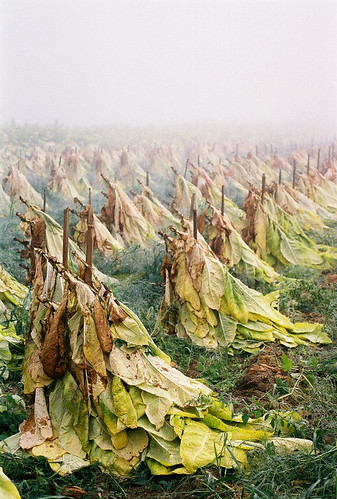
Tobacco in the Field, originally uploaded by Mike the B.

Tobacco is one of the most strange, unusual, misunderstood and challenging notes in perfumery. There seems to be a fair amount of mystery surrounding fragrances from the tobacco family, which is why it makes a perfect fit for the “Decoding Obscure Notes” series.

Tobacco as a fragrance family name is used almost interchangeably with Leather. Interestingly, the relationship between perfume and those two seemingly unrelated artifacts are quite fascinating.

Origins
Like several other important members of the nightshade (Solanaceae) family, tobacco is native to the Americas and the West Indies. There are two main species of tobacco that are used aromatically, medicinally and commercially. Nicotiana rustica, which is a wild tobacco that is native to the West Indies and Eastern North America (i.e.: USA and some parts of Canada), and was the one used by native Americans since time immemorial; and Nicotiana tabacum which is indigenous to Central and South America and only later cultivated with much commercial success in North America in the state of Virginia. The name tobacco likely originated in the Tahitian word “tabaco”, a Y shaped pipe for inhaling the plant’s smoke through both nostrils.

History & Cultural Significance
Tobacco is a sacred plant in all Native American tribes. The first to use it were probably the Mayan Indians, and its use was spread throughout the entire continent. Tobacco was an essential element in most Native American rituals, and was used in different ways: placed as an offering to the gods or the spirits, burnt on the fire, smoked in a pipe or the leaves were rolled into the ancient forms of cigars in South and Central America (at times also elaborately decorated). Pipes were smoked to “seal deals” and agreements between tribes. The pipes themselves have a symbolic meaning: the “straw” part is considered projective or masculine, and the bowl where the tobacco is burnt is considered receptive, or feminine. There is a significance to the materials from which the pipes are made as well, and cultural messages hidden within the decoration of some pipes (which has become particularly elaborate in Central and Southern America).

Medicinal Properties and Health Issues
The Indians’ reverence for the plant and great respect to its powers prevented them from becoming addicted to it. They usually did not inhale the smoke when smoking the pipe. And the plant was used medicinally to treat many ailments (asthma, fever, bites, stings, and to clear the head). Tobacco was administered in different ways – i.e.: chewing, snuff and smoking.

Tobacco’s medicinal properties seem quite aggressive – it’s considered a “sedative, diuretic, expectorant, discutient, and sialagogue, and internally only as an emetic, when all other emetics fail” (Botanical.com) but I suppose there is place for these actions too in some cases, as long as it is used appropriately and with caution.

The principle constituent in tobacco is nicotine (by the way – both the chemical and the Latin name for tobacco are named after Jean Nicot, the French ambassador in Portugal, introduced the plant to France). This alkaloid a clear, poisonous oil and appears in larger proportion in the plants grown in their native territories.

Ironically, once introduced to the Western world by the European invaders, tobacco has become one of the most dangerous plant substances in the world, resulting in illness and death of millions one in every ten adults dies from tobacco use world wide. Every 8 seconds someone dies because of tobacco. And to read more grim facts about the consequences of tobacco abuse, click here). And if you’re interested in digging even deeper into the history and the medicinal uses of tobacco, read this.

Curing Tobacco
What do leather and tobacco have in common? Quite a lot, actually. Both require a curing process before they can be used. And in both cases, aromatic substances and perfuming are involved in different stages of the process.

Like several aromatic botanicals used in perfumery, tobacco requires a fair amount of processing before being used (or extracted). For example: vanilla beans must be left in the sun to cure to bring out the vanillin; patchouli leaves must be dried and matured for quite sometime to improve their scent; and iris rhizomes must be peeled, dried and stored for 3 years before they are extracted to produce orris butter. In the case of tobacco, the raw leaves have a bitter taste and not a particularly pleasant smell either. Nicotine, the substance that gives tobacco most of its medicinal (and addictive) properties, supposedly also protects it from insects and makes it not a very friendly or attractive thing in its raw form. Although it was used raw medicinally (the leaves were chewed or squeezed for their juice), it is hardly the sophisticated aromatic that we have learned to recognize as tobacco.

Tobacco leaves acquire their distinct aroma only after they have been cured, a process that involves the alchemical work of enzyme to change their aroma, colour and flavour. Curing can be done in several methods to produce different results and types of tobacco.

Air Curing is a relatively simple process although it has a few stages. Depending on the climate of where the tobacco is grown (i.e.: how humid or hot the air is plays an important factor), the leaves are simply air dried, either outdoors or indoors in well-ventilated curing barns or champers especially built for them (usually right near the fields). What you see in the photo above is the original method for curing, where the entire plant is cut and placed upside down so that the leaves air-dry straight (more or less). Air curing can also take place indoors, in curing barns with a gradually increasing temperature from 33 to 77 degrees Celsius over a period of 5-7 days. Once dried, the leaves are brittle and fragile; therefore, the doors of the barn are opened on a humid day so that the leaves are soft again and can be removed from the stems and stacked into piles of about 20 leaves per pack. They are left there to fully ferment and develop a uniform brown colour. The process takes about 8 weeks. The result is a tobacco that is light in flavour, and has higher level of nicotine.

Fire Curing occurs indoors in curing barns where hardwood fire is kept for several days to produce a smouldering smoke. This also produces a high nicotine level and is mostly used for pipe tobacco, chewing tobacco and snuff.

Flue Curing is a method that heats the curing barn through pipes, without the exposure to the smoke itself. Flue curing produces a tobacco that has more sugar, and less nicotine, that is used for cigarettes.

Sun-Cured tobacco is the result of leaving the tobacco outdoors and exposed to the sun. After 4-5 days in the sun, the leaves are taken indoors into a well-ventilated barn at 22 degrees Celsius where they will become soft and can be packed. This method is mostly is used in the Mediterrenean region (Turkey, Greece, etc.) to create oriental tobacco, which is used in cigarettes and hooka (sheesha) blends and is low in both sugar and nicotine.

After curing, there is a process of fermentation: The stacked leaves are left to ferment until they reach once the leaves are stacked, and reach a temperature of about 55 degrees Celsius. After a month they will reach a uniform brown colour, and than they are prized which entails pressing the bundles of leaves into big bulks of 1000lb each. The pressure has to be just right to avoid discoloration of the leaves; and often times rum, vanilla or molasses are added as well at this stage.

Labels: , , , , , ,

Monday, November 02, 2009

Bvlgari Black


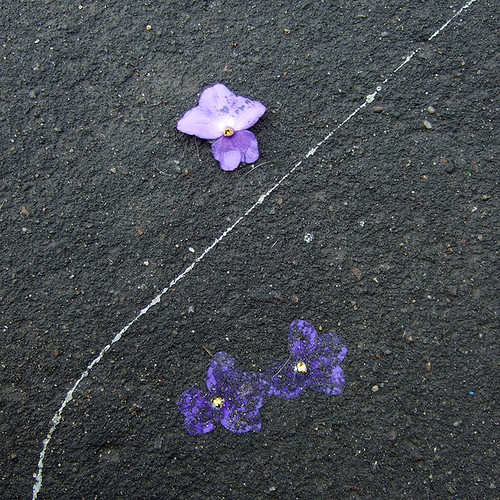
Crushed violets, originally uploaded by oksidor.

“Forgiveness is the fragrance that the violet sheds on the heel that has crushed it.” (Mark Twain)

In the summertime, Bvlgari Black wears like a molten asphalt and roof tar, underlined by purring black cat’s fur. Intense and linear, it grows on the skin until it becomes unbearable. In the cooler fall weather, it wears like a woolen sweater contaminated by the smoke escaping from the fireside. And a cup of Lapsang Suchong comes to mind. But this is only temporary: soon violets take over. Violent violets of the candid kind that you can find in the two Lolita Lempicka and the Au Masculin (both are also by Annick Menardo). It also is quite similar to two other masculines that played florals in a cheeky way: Joop! (Michel Almairac) and Le Male (Francis Kurkdjian) - a trend that most likely began with Geoffrey Beene's Grey Flannel (André Fromentin).


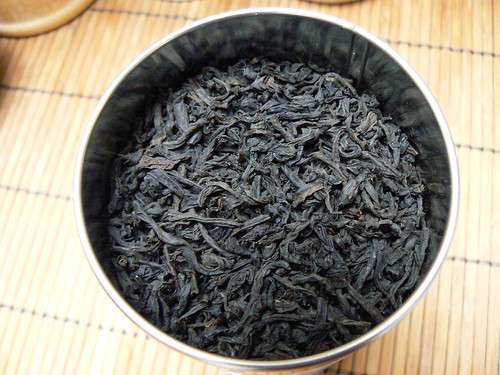
Lapsang Suchong, originally uploaded by Ayala Moriel.

Bvlgari Black is intriguing and quirky and reminds me of both the smoky tea of Dzing! And Tea for Two (both created by Olivia Giacobetti for l’Artisan Parfumeur). I’m still not decided which one of the three I like the best. The dry down of Bvlgari Black is a rich though not smouldering vanilla, reminiscent of Shalimar's counterpoint between sweets and smokes, confection and leather.

Labels: , , , , , , , , ,

Tuesday, October 13, 2009

Tea for Two

The smokiness of Lapsang Suchong makes Tea for Two a little quirkier than the name suggests, and not in the least dreamy Doris-Day-like but a little tongue-in-your-cheek instead. If this was an Earl Gray I'm sure it would be easy to find a partner to sip that concoction with. But this is a smoky tea, and as such it is more reminiscent of leather and the marvelous, gamey Dzing! than to what normal people expect from a cup of tea.

If it wasn't for the addition of sugar and milk – which in the perfume universe comes from sweet notes of honey and vanilla and the warmth from spices such cinnamon and ginger - it would be as difficult to put on as a leather jumpsuit. But these notes, and the barest hint of floral jasmine and rose help to round it off and accentuate the tea leaf while taking away some of the smoke. In fact, there is the barest hint of green leaf or honeysuckle once it settles on the skin. That is not to say that Tea for Two becomes floral or green, but these aspects certainly help give this perfume roundness and dimension without risk of straying off the tea-theme. The tea backdrop becomes more woody and subdued as it evolves on the skin, and the anise grows a little bolder with time.

Having elements of both spice and the leather genre, I find Tea for Two to be perfect for fall. It’s warm and cozy as a sweater and has a personality of its own too, in case you are in the mood for getting a new one for the season.

Notes: Smoked Black Tea (Lapsang Suchong), Ginger, Cinnamon, Anise, Honey, Vanilla

Labels: , , , , ,

Thursday, May 22, 2008

Mental Notes: Burnt Proteins, Anyone?


Bonfire Night, originally uploaded by adraskoy.

With summer just around the corner, the stench of barbecue is already starting to overwhelm me. As soon as it doesn't rain, some people feel the urge to fill with air with the smoke of burning charcoal and meat. There is something about burning protein that I just can't get myself to appreciate. Perhaps if I wasn't vegetarian it could have been different. Perhaps it also explains why I usually avoid the Lag BaOmer bonfires (Happy Lag BaOmer, by the way!).

Today I was wearing my 3rd mod for the ginger & amber perfume and it goes stronger than the previous ones. This one has a touch of marigold and immortelle in it, making it sunny but also with a greater depth and slightly animialistic undertone, maybe even a tad smoky.

It's strange, I love smoky notes in perfume, but in real life it makes me immediately uneasy, even if just a little. It's the smell of danger.

Labels: , ,